



Why Scalable API Management is Key for Future Growth
The word "scalable" in API management signifies more than just handling increased traffic. It means the platform can effortlessly accommodate an expanding number of APIs, diverse integration patterns, fluctuating demand, and more.

TL;DR
1. Digital transformation demands API management that scales effortlessly with your growing API portfolio, ensuring performance and reliability.
2. Non-scalable approaches lead to technical debt, security vulnerabilities, siloed operations, and hinder innovation.
3. A truly scalable API management platform unifies gateways, automates lifecycle, provides robust security, and offers deep analytics.
4. Critically, it must be multi-cloud, hybrid-ready, and designed to support future AI-driven API consumption.
5. DigitalAPI.ai provides an enterprise-grade, scalable API management solution that centralizes visibility, automates governance, and future-proofs your API estate.
Future-proof your API strategy with DigitalAPI.ai. Book a Demo!
In a world increasingly orchestrated by code, APIs aren't just technical components; they are the connective tissue of modern business. They power everything from customer experiences and partner integrations to internal microservices and AI-driven automation. As organizations build more APIs, expose more data, and connect more systems, the underlying infrastructure that manages these digital interactions must keep pace. The ability to grow, adapt, and secure your API landscape isn't merely a technical consideration, it's a strategic imperative for sustained innovation and market leadership. The challenge lies not in creating APIs, but in managing their proliferation with agility and foresight, making a truly scalable API management platform indispensable.
The Imperative of API Management in the Digital Era
API management is no longer a niche concern for development teams; it's a foundational pillar for any enterprise navigating the complexities of digital transformation. It encompasses the entire lifecycle of an API, from its initial design and development through deployment, versioning, security, monitoring, and eventual deprecation. Effective API management ensures that APIs are discoverable, well-documented, secure, and performant for both internal and external consumers.
Without a robust API management strategy, organizations face a litany of problems: inconsistent security policies, poor developer experience, duplicated efforts, a lack of visibility into API usage, and ultimately, stifled innovation. As companies expand their digital footprint, the sheer volume and diversity of APIs make manual management untenable. This is where the concept of a scalable API management platform moves from a "nice-to-have" to a "must-have." It’s the engine that allows businesses to unlock the full potential of their API economy without being overwhelmed by its complexity.
Why "Scalable" API Management is Non-Negotiable
The word "scalable" in API management signifies more than just handling increased traffic. It means the platform can effortlessly accommodate an expanding number of APIs, diverse integration patterns, fluctuating demand, evolving security threats, and the need for consistent API governance across heterogeneous environments. For future growth, a scalable platform is critical for several reasons:
1. Handling Exploding API Portfolios
As microservices architectures become standard and organizations embrace composable business models, the number of APIs in an enterprise grows exponentially. Each new feature, product, or integration often involves multiple APIs. A non-scalable system buckles under this load, leading to unmanaged API sprawl, undocumented services, and a chaotic developer landscape. A scalable platform provides the tools to manage thousands of APIs, internal, external, partner, and legacy, from a single pane of glass, ensuring every API is discoverable, governed, and linked to its lifecycle.
2. Adapting to Diverse API Types and Gateways
Modern enterprises rarely rely on a single API gateway or a single API style. They operate with a mix of REST, GraphQL, event-driven APIs, and even SOAP services, deployed across various gateways like Apigee, MuleSoft, AWS API Gateway, Kong, Azure API Management, and NGINX. A scalable API management platform must be gateway-agnostic, capable of abstracting and unifying these disparate environments. It needs to provide a consistent management layer over this complex ecosystem, ensuring that policies, analytics, and security measures apply uniformly, regardless of where the API physically resides.
3. Ensuring Performance and Reliability at Scale
Customer expectations for digital services are at an all-time high. Slow-loading applications, unreliable integrations, or downtime can severely impact user experience, brand reputation, and revenue. A scalable API management platform is designed to handle massive traffic spikes and sustained high loads without degradation in performance. This involves intelligent load balancing, caching, throttling, and robust failover mechanisms. It ensures that your APIs remain responsive and reliable, even as your business expands and user demand fluctuates.
4. Strengthening Security and Compliance Across the Estate
Every API exposed is a potential entry point for security threats. As the API surface area grows, so does the attack surface. A scalable platform provides a centralized control point for enforcing consistent security policies—authentication, authorization, encryption, threat protection, and rate limiting, across your entire API portfolio. It's also crucial for meeting regulatory compliance (e.g., GDPR, CCPA, HIPAA) by providing audit trails, data governance, and consistent access controls across all APIs, regardless of their underlying infrastructure or data source.
5. Powering Digital Transformation and Innovation
Digital transformation hinges on the ability to rapidly build, deploy, and iterate on new digital services. APIs are the building blocks of this transformation. A scalable API management platform accelerates innovation by making APIs easily discoverable and consumable for developers, fostering reuse, and reducing time-to-market for new applications and partnerships. It enables businesses to experiment with new models, integrate with emerging technologies, and quickly respond to market demands without being bottlenecked by API infrastructure limitations.
.png)
The Pitfalls of Non-Scalable API Management
While the benefits of scalable API management are clear, the consequences of neglecting it can be severe and far-reaching, impacting not just technical teams but the entire business. Non-scalable approaches, often pieced together with siloed tools or manual processes, quickly become liabilities.
1. Manual Processes and Technical Debt
Relying on spreadsheets, ad-hoc scripts, or manual updates for API documentation, security policies, and lifecycle management inevitably leads to technical debt. As the number of APIs grows, these manual processes break down, introducing errors, inconsistencies, and significant operational overhead. Developers waste valuable time searching for documentation, creating duplicate APIs, or waiting for manual approvals, which directly impacts productivity and time-to-market.
2. Siloed Operations and Inconsistent Governance
Without a centralized, scalable platform, API management often becomes fragmented. Different teams use different tools, apply varying standards, and lack a unified view of the entire API estate. This results in "shadow APIs" that are unknown to central governance, inconsistent security postures, and a general lack of control. This operational silo leads to compliance risks and makes it impossible to enforce uniform standards across the organization.
3. Performance Bottlenecks and User Frustration
An API management system that cannot scale with demand quickly becomes a bottleneck. Inability to handle high traffic volumes results in slow API responses, timeouts, and service outages. This directly affects the performance of applications that rely on these APIs, leading to poor user experiences, churn, and damage to brand reputation. Performance issues can be particularly crippling during peak business periods or major digital campaigns.
4. Security Gaps and Compliance Headaches
Fragmented API management makes it nearly impossible to maintain a consistent security perimeter. Varied authentication mechanisms, disparate authorization policies, and a lack of centralized threat detection leave the organization vulnerable to attacks. Furthermore, proving compliance with data privacy regulations becomes an arduous and often incomplete task when there's no single source of truth for API access, usage, and data handling policies.
5. Stifled Innovation and Slowed Time-to-Market
Perhaps the most significant long-term pitfall is the drag on innovation. When developers struggle to discover, understand, or securely integrate with existing APIs, they resort to rebuilding functionalities or getting stuck in endless approval loops. This friction slows down the development of new products and services, prevents rapid experimentation, and ultimately handicaps the organization's ability to compete effectively in a fast-evolving digital landscape.
Key Features of a Scalable API Management Platform
To truly enable future growth, a scalable API management platform must offer a comprehensive set of features designed for enterprise-grade complexity and evolving digital demands. It's about combining robustness with flexibility and automation.
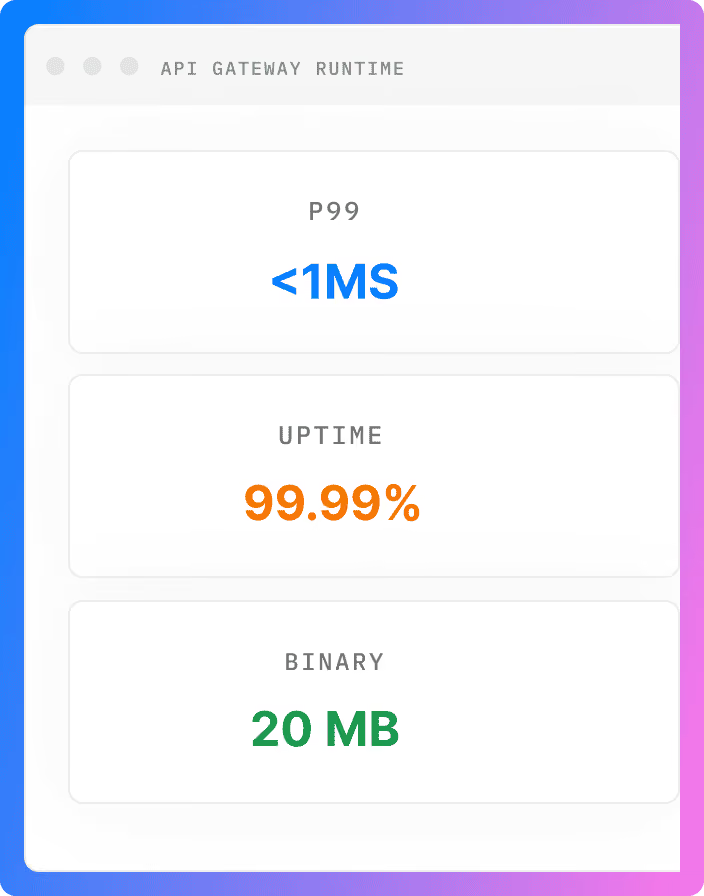
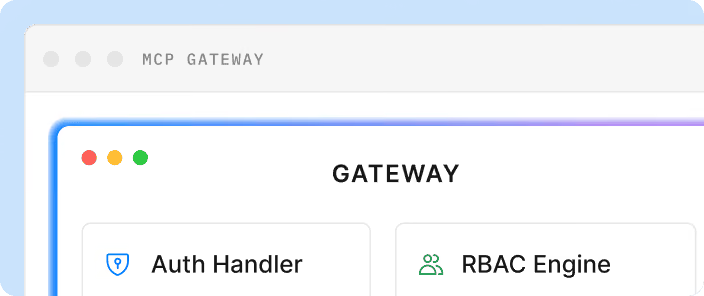
- Unified API Gateway and Proxy Capabilities: A centralized, high-performance API gateway is fundamental. It acts as the single entry point for all API traffic, routing requests, applying policies, and ensuring security. A scalable gateway can dynamically adjust resources to meet demand, supports advanced routing logic, and provides real-time traffic management capabilities across multiple environments, even hybrid or multi-cloud setups.
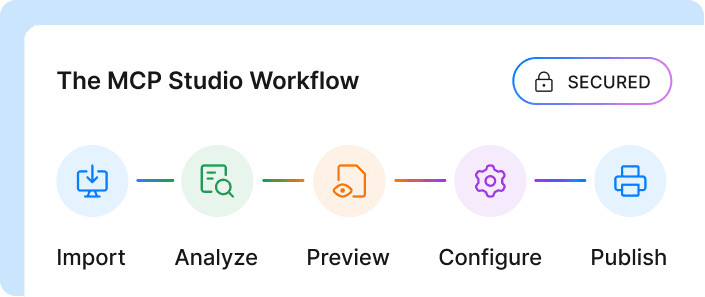
- Comprehensive API Lifecycle Management: From design and development to testing, deployment, versioning, and deprecation, the platform should manage the entire API lifecycle. This includes robust API cataloging, schema validation, automated documentation generation, and tools for seamless version transitions. It ensures consistency, reduces manual effort, and promotes reuse, keeping the API estate tidy and up-to-date.
- Advanced Security and Access Control: Scalability without security is a vulnerability. The platform must provide granular access control (OAuth, JWT, API keys), threat protection (DDoS, injection attacks), encryption, and robust policy enforcement. It should integrate with existing identity providers (IdP) and offer features like rate limiting, quotas, and anomaly detection to protect against misuse and malicious activity at a global scale.
- Real-time Analytics and Monitoring: Visibility is key to performance and optimization. A scalable platform offers real-time dashboards for API health, usage patterns, error rates, and latency. It provides actionable insights into API performance, helps identify bottlenecks, informs capacity planning, and supports business intelligence by tracking API consumption metrics, enabling data-driven decision-making for future growth and investment.
- Automated Developer Portal and Documentation: A self-service developer portal is crucial for fostering API adoption. It should automatically generate interactive documentation, provide code samples, facilitate API discovery through search and categorization, and enable developers to test APIs directly. Automation ensures documentation is always current, drastically reducing the friction for internal and external developers to find and integrate with APIs.
- Multi-Cloud and Hybrid Environment Support: Modern enterprises operate across diverse infrastructures. A truly scalable platform isn't confined to a single cloud provider or on-premises setup. It should support multi-cloud deployments (AWS, Azure, GCP), hybrid architectures, and even edge computing, allowing you to manage APIs wherever they reside without creating new silos or requiring complex workarounds.
- AI-Ready Capabilities for Future-Proofing: The advent of AI agents and machine-driven automation requires APIs to be not just human-readable but machine-consumable. A scalable API management platform should structure API metadata, specifications, and governance rules in an AI-friendly format, paving the way for autonomous API discovery, invocation, and orchestration by AI systems, thereby future-proofing your API strategy.
.png)
How DigitalAPI.ai Delivers Scalable API Management for Future Growth
DigitalAPI.ai understands that future growth isn't about simply having more APIs; it's about managing them intelligently and at scale. Our platform is engineered to address the core challenges of distributed API ecosystems, providing a unified, automated, and AI-ready solution that empowers enterprises to innovate confidently.
1. Centralized Visibility Across Your Entire API Estate
DigitalAPI eliminates API sprawl by aggregating APIs from all your existing gateways (Apigee, MuleSoft, AWS, Kong, Azure), Git repositories, and internal services into a single, comprehensive API catalog. This provides unparalleled visibility into your entire API portfolio, making every API discoverable and ensuring no service goes unmanaged, regardless of its origin or type. This unified view is the first step towards truly scalable management.
2. Automated Governance and Lifecycle Control
Our platform automates critical governance tasks, from validating OpenAPI/RAML specifications to enforcing consistent security policies and lifecycle stages. DigitalAPI ensures that every API adheres to your organization's standards, reducing manual overhead and preventing configuration drift. This automation is crucial for scaling governance across a rapidly growing number of APIs without sacrificing compliance or quality.
3. Robust Security and Performance Optimization
DigitalAPI provides a robust layer for applying security policies, including authentication, authorization, rate limiting, and threat detection, consistently across all managed APIs. Our architecture is designed for high performance, ensuring that your APIs can handle escalating traffic demands reliably and efficiently. We empower you to maintain peak performance and strong security posture as your API landscape expands.
4. Developer-Centric Experience for Rapid Adoption
With DigitalAPI, developers benefit from an intuitive, self-service portal where they can easily discover, understand, and integrate with APIs. Automated documentation generation, interactive try-it-out consoles, and clear usage examples significantly accelerate developer onboarding and adoption. This empowers teams to build faster and reuse existing services, directly fueling your organization's capacity for rapid innovation.
5. Future-Proofing with AI and Machine-Readable APIs
DigitalAPI is built with the future in mind. We structure your API metadata and specifications in a machine-readable format, making your entire API estate AI-ready. This ensures that your APIs can be seamlessly discovered, evaluated, and invoked by AI agents and automated systems, laying the groundwork for the next generation of intelligent applications and autonomous workflows. By preparing your APIs for the agentic era, DigitalAPI.ai ensures your platform remains relevant and powerful for years to come.
FAQs
1. What is a scalable API management platform?
A scalable API management platform is a system designed to effectively manage an ever-growing number of APIs, handle increasing traffic volumes, adapt to diverse API types and environments (multi-cloud, hybrid), and enforce consistent governance and security policies across the entire API ecosystem without performance degradation or operational bottlenecks. It's built for elasticity and long-term enterprise growth.
2. Why is scalable API management crucial for future growth?
Scalable API management is crucial for future growth because it enables organizations to keep pace with digital transformation. It prevents API sprawl, ensures reliability and performance under load, strengthens security across an expanding attack surface, accelerates innovation by empowering developers, and allows businesses to adapt rapidly to new technologies and market demands without their API infrastructure becoming a limiting factor.
3. What are the key features of a truly scalable API management platform?
Key features include a unified API gateway for centralized traffic management, comprehensive API lifecycle management, advanced security and access controls, real-time analytics and monitoring, an automated developer portal for self-service, multi-cloud and hybrid environment support, and AI-ready capabilities for future automation. These features collectively ensure resilience, efficiency, and adaptability.
4. How does a scalable platform handle diverse API types and gateways?
A scalable platform acts as an abstraction layer, capable of integrating and managing APIs regardless of their type (REST, GraphQL, event-driven) or where they are deployed (e.g., Apigee, MuleSoft, AWS, Kong, Azure, Git). It provides a consistent management plane over these heterogeneous environments, applying uniform policies, monitoring, and governance without requiring teams to migrate or re-architect their existing services.
5. How does DigitalAPI.ai contribute to scalable API management?
DigitalAPI.ai provides a unified platform that connects all API sources, normalizes specs and metadata, automates governance, and publishes APIs via a developer-friendly portal. It ensures robust security and performance, and crucially, structures API data in an AI-ready format, enabling enterprises to manage their entire API estate at scale while future-proofing it for AI-driven automation and continuous innovation.
Dhayalan Subramanian is Associate Director, Product Growth at DigitalAPI, where he leads go-to-market and product growth for the company’s multi-gateway API management platform. His work focuses on helping large enterprises and mid-market cloud companies consolidate APIs across AWS, Azure, Apigee, Kong, MuleSoft, and other gateways into a single control plane for governance, discovery, monetization, and agent consumption.
Dhayalan brings 14+ years of experience across product strategy, enterprise architecture, and engineering leadership. Earlier in his career, he held senior roles at Encora (as Associate Architect and Technical Manager), Mindtree (Technology Lead), Tech Mahindra (Technical Lead), and Primus Analytics, where he designed integration frameworks and delivered enterprise-grade digital platforms for global customers.
At DigitalAPI, he works directly with platform, integration, and developer experience leaders at Fortune 500 organizations to operationalize unified API catalogs, developer portals, and MCP-ready APIs. He writes regularly on API developer experience, API governance, and AI agent architectures.

One email a fortnight. Worth opening.
A short digest of what we're writing, what we're learning from customers, and the handful of links you'd actually want from us. No tracking pixels.

.avif)