



MuleSoft vs Apigee: Choosing the right tool for your API strategy
For enterprise architects and CIOs, the debate between MuleSoft and Apigee is rarely a simple feature comparison.

TL;DR
This guide compares MuleSoft and Apigee to help enterprise architects choose the right tool. MuleSoft is an integration engine (iPaaS) best for connecting legacy systems like mainframes to modern apps like Salesforce. Apigee is an API management platform best for securing, managing, and monetizing APIs for external partners.
Key takeaways
Architecture: MuleSoft runs on a heavy Java engine for complex logic; Apigee uses a lightweight Nginx proxy for high speed.
Data Handling: MuleSoft transforms data (ETL) using DataWeave; Apigee controls traffic and security.
Pricing: MuleSoft charges for vCore capacity (compute); Apigee charges for API call volume.
Migration: Moving between them is hard due to logic and language lock-in.
The Solution: Most enterprises need both. DigitalAPI.ai offers a centralized command center to manage MuleSoft and Apigee together, giving you unified governance and analytics without vendor lock-in.
Stop the sprawl. Get centralized control now. [Book a Demo!]
For enterprise architects and CIOs, the debate between MuleSoft and Apigee is rarely a simple feature comparison. It is a fundamental choice between two distinct architectural philosophies: heavy-duty integration versus high-speed API management. Organizations often conflate these tools because they both manage APIs. However, their primary functions are vastly different.
MuleSoft is an integration platform designed to connect disjointed systems like SAP, Salesforce, and legacy mainframes. Apigee is an API management platform built to secure, govern, and monetize traffic at the edge. This guide dissects the engineering reality of both platforms. We analyze their architectural differences, pricing models, and data strategies to help you decide which tool fits your roadmap.
Understanding the core difference
The most critical mistake stakeholders make is viewing these tools as direct competitors for the same task. While there is overlap, their centers of gravity lie in completely different architectural layers.
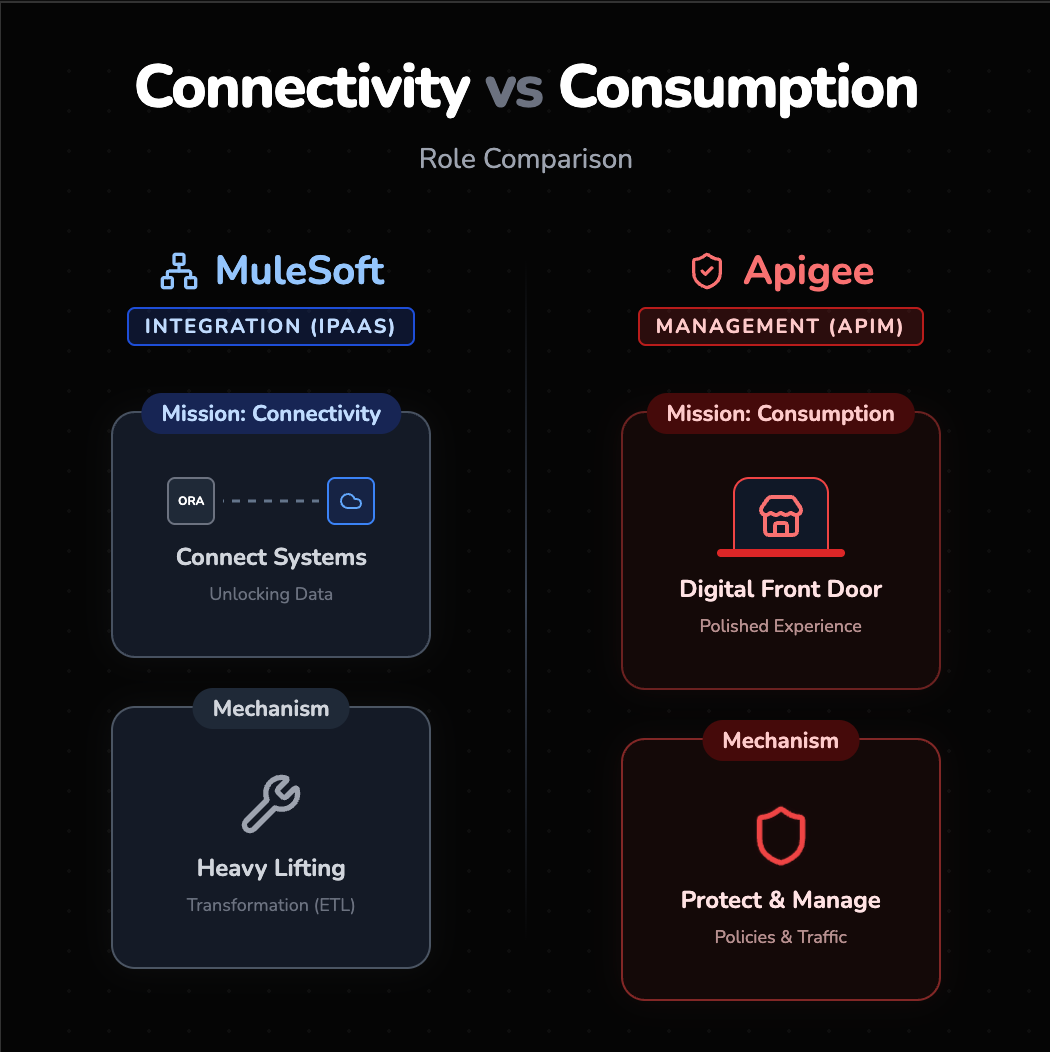
Integration vs. management: What they actually do
MuleSoft operates primarily as an Integration Platform as a Service (iPaaS). Its core mission is connectivity. If your problem involves unlocking data from a dusty on-premise Oracle database, transforming that data from a complex XML schema into a clean JSON format, and then pushing it into Salesforce, MuleSoft is the correct tool. It excels at the heavy lifting required to make systems talk to each other.
Apigee operates as a full-lifecycle API Management Platform. Its core mission is consumption. Apigee assumes the data is already accessible. It sits in front of your services to enforce security policies, manage traffic spikes, and provide a polished developer portal for external partners. It does not want to connect to your mainframe; it wants to protect the API that connects to your mainframe.
Choosing your ecosystem: Salesforce or Google?
Your decision also implies a long-term commitment to a specific cloud ecosystem. The choice of MuleSoft is logical if your organization is heavily invested in the Salesforce ecosystem. Since Salesforce acquired MuleSoft, the platform has become the de facto pipe for moving data in and out of Salesforce clouds. It offers pre-built connectors and accelerators that dramatically speed up Salesforce integrations.
The choice of Apigee makes sense if you are aligning with Google Cloud Platform (GCP). As a Google Cloud solution, Apigee offers native integration with Google’s analytics (BigQuery) and security (Cloud Armor) tools. It acts as the gateway to the Google ecosystem, making it a natural choice for enterprises moving workloads to GCP.
Head-to-head comparison
We must look under the hood to understand how these platforms perform in production. The architectural differences dictate everything from latency to the daily developer workflow.
MuleSoft for integration. Apigee for management. One layer for both.
See How DigitalAPI Governs Both
I. Architecture: Heavy engine vs. light proxy
MuleSoft runs on the Mule Runtime, a heavy Java-based engine based on the Spring framework. This runtime is powerful because it is essentially an application server. It can execute complex logic, hold state, and run orchestration flows. However, this power comes with weight:
- Resource intensive: Mule apps are deployable units that require significant compute resources (memory and CPU).
- Orchestration focus: Ideally suited for complex logic flows (e.g., call System A, wait for response, transform, call System B).
Apigee uses a fundamentally different architecture based on the Nginx proxy model. It is designed to be lightweight and fast. In the Apigee architecture, the "Message Processor" handles traffic. It receives a request, executes a chain of policies, and instantly routes the traffic to the backend.
- Lightweight proxy: It does not try to be an application server; it is a highly optimized reverse proxy.
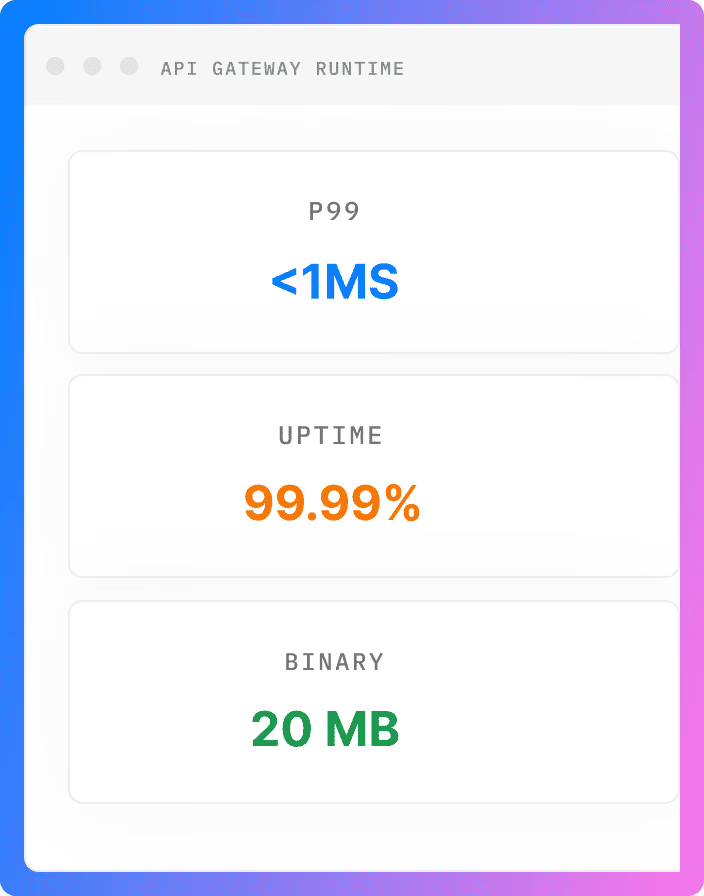
- High concurrency: Designed to handle 100,000+ requests per second with sub-millisecond overhead.
This distinction matters for performance. Complex orchestration suits MuleSoft’s architecture perfectly. High-volume traffic scenarios requiring massive throughput with sub-millisecond overhead require Apigee’s superior proxy architecture.
II. Data handling: Transformation vs. control
The way these platforms treat data highlights their divergent goals.
MuleSoft views data as something to be transformed. It possesses one of the most powerful transformation engines in the industry: DataWeave. This functional programming language allows developers to:
- Perform complex ETL: Execute Extract, Transform, Load operations in real-time.
- Map formats: Ingest flat files and map them to canonical XML schemas.
- Enrich payloads: Add data from database lookups before outputting JSON.
Apigee views data as something to be controlled. It typically does not want to inspect the full payload unless necessary. Instead, it looks at the metadata: the headers, the tokens, and the URI parameters. Apigee focuses on traffic shaping:
- Rate limiting: Enforces strict limits to protect backends from being overwhelmed.
- Security validation: Validates OAuth tokens to ensure strict security.
- Performance first: Avoids complex data manipulation, which is considered an anti-pattern that degrades performance.
III. Developer tools: IDE vs. web console
The daily life of a developer differs significantly between the two ecosystems.
MuleSoft developers work primarily in Anypoint Studio, a desktop IDE based on Eclipse. It provides a visual, drag-and-drop interface where developers verify flows, drag connectors onto a canvas, and configure properties. It is a heavy, developer-centric environment that requires a local setup.
- Visual design: Drag-and-drop interface for building integration flows.
- Local setup: Requires installation and configuration on a developer machine.
- Code-heavy feel: The workflow feels like traditional software engineering.
Apigee developers work primarily in a Web-based GUI or via text-based configuration files. The Apigee console allows users to visualize API proxies as flowcharts where policies are attached to the request or response flow.
- Web-based: Accessible from any browser with no local installation required.
- Configuration focus: You are configuring policies, not writing application logic.
- CI/CD friendly: Supports modern GitOps workflows with text-based config files.
IV. Pricing models: Paying for capacity vs. volume
Cost structure is often the deciding factor for procurement teams.
MuleSoft utilizes a vCore-based pricing model. You purchase a certain amount of computing capacity (vCores). Every application you deploy consumes a portion of that capacity. This model is predictable but can become expensive as you scale.
- Capacity-based: You pay for the ability to run logic.
- Costly scaling: Adding more microservices consumes more vCores, increasing cost.
- Traffic independent: You pay for reserved capacity, even if traffic is low.
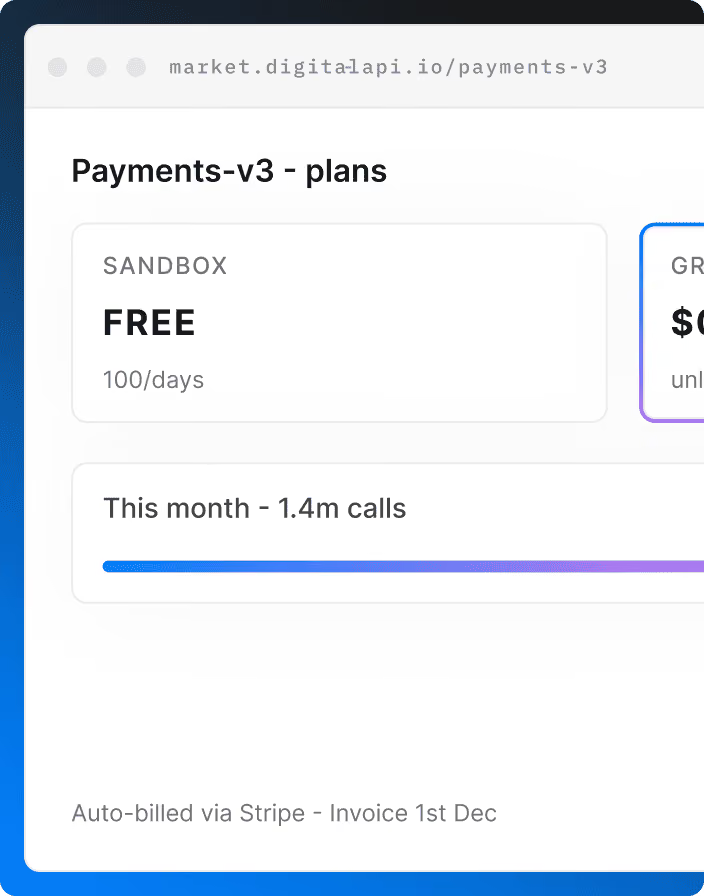
Apigee typically utilizes a subscription or volume-based pricing model. You pay for the volume of traffic flowing through the gateway. This model is generally more scalable for high-throughput, low-complexity APIs.
- Volume-based: You pay for the API calls you serve.
- Scalable: You are not penalized for deploying many idle proxies.
- Value-aligned: Cost aligns with the value realized (traffic served).
The migration reality: What it takes to switch
Switching platforms is never as simple as "export and import." The deep architectural differences between MuleSoft and Apigee create specific migration hurdles that IT leaders must anticipate to avoid project stalls.
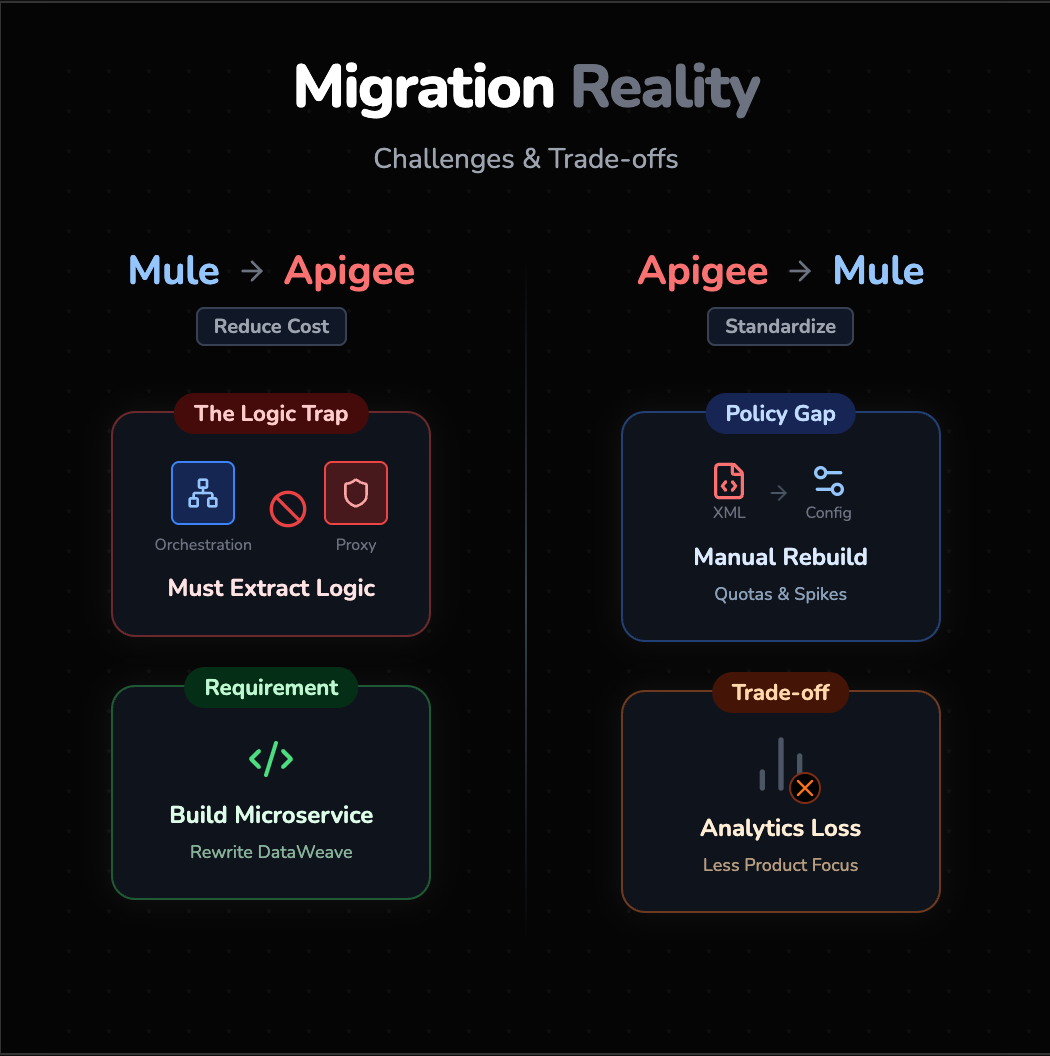
Moving from MuleSoft to Apigee
This is often driven by a need to reduce vCore costs for simple proxy use cases.
- The "logic trap": You cannot simply move a Mule app to Apigee. Mule apps often contain complex orchestration logic (e.g., "If customer is VIP, call database A, else call database B"). Apigee is not designed for this. You must rewrite this logic in a microservice code (Java, Node.js) and place it behind Apigee.
- DataWeave dependency: Scripts written in MuleSoft’s proprietary DataWeave language do not run anywhere else. Migrating means rewriting every transformation script into standard code or using a different transformation engine.
Moving from Apigee to MuleSoft
This is less common but happens when an organization standardizes on Salesforce.
- Policy translation: Apigee policies (XML-based) for things like Quotas, Spike Arrests, and OAuth verification have no direct 1-to-1 equivalent in MuleSoft. Developers must manually rebuild these governance rules using MuleSoft's "API Manager" policies.
- Loss of analytics: Apigee’s analytics are deeply granular for external product management. Moving to MuleSoft often means losing that specific "product-centric" view unless you invest heavily in configuring Anypoint Monitoring.
Real-world scenarios: When to use which?
Understanding the technical specs is one thing, but seeing them in action clarifies the choice. Here are three common scenarios that dictate the right tool.
Scenario A: The legacy overhaul (MuleSoft)
A global manufacturing company needs to modernize its supply chain. Their inventory data is trapped in an on-premise mainframe, and they need to push it to a new Salesforce CRM.
- The challenge: Unlocking old, heavy data formats and moving them securely.
- The solution: MuleSoft connects to the mainframe, transforms the complex XML data into JSON, and orchestrates the flow into Salesforce.
Scenario B: The open banking launch (Apigee)
A large retail bank has already built modern microservices for checking balances and making transfers. Now, they need to expose these services to third-party fintech apps to comply with Open Banking regulations.
- The challenge: Securely exposing APIs to external partners while managing traffic spikes.
- The solution: Apigee sits in front of the microservices, providing a secure developer portal, enforcing strict OAuth policies, and monetizing access for partners.
Scenario C: The enterprise reality (Both)
A Fortune 500 retailer finds itself with both problems. They use MuleSoft to manage internal inventory flows and Apigee to power their mobile app.
- The challenge: Fragmented governance, separate analytics dashboards, and vendor lock-in.
- The solution: The organization adopts a federated approach, using a centralized control plane to view analytics and enforce policy across both MuleSoft and Apigee without replacing either.
Decision flowchart: Making the call
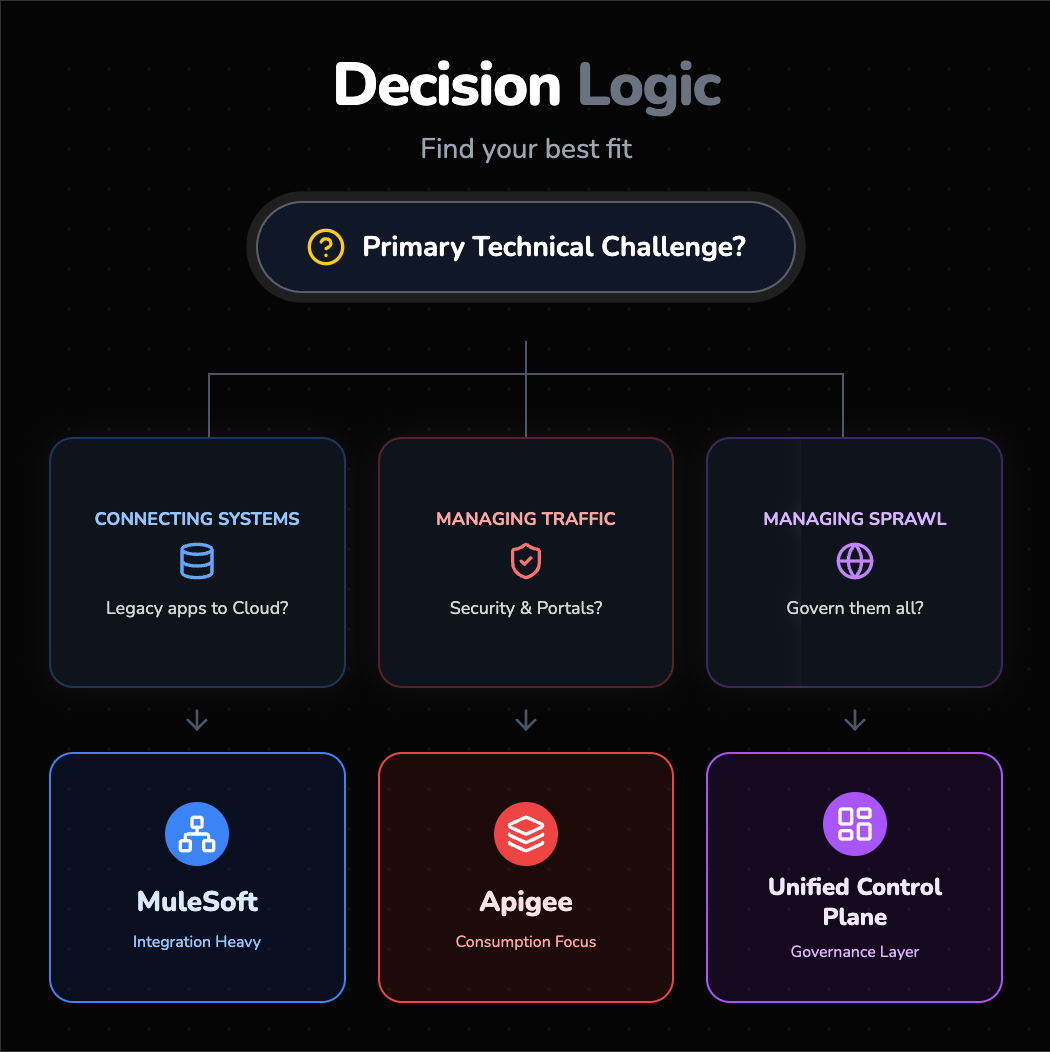
Stuck on the fence? Use this simple logic flow to determine the best fit for your immediate need.
Start here: What is your primary technical challenge?
- If "Connecting Systems":
- Do you need to connect legacy apps (SAP, Oracle) to modern cloud apps?
- YES -> Choose MuleSoft.
- If "Managing Traffic":
- Do you have ready-made APIs that need security, rate limiting, and a developer portal?
- YES -> Choose Apigee.
- If "Managing Sprawl":
- Do you already have MuleSoft, Apigee, or AWS Gateway and need to govern them all?
- YES -> Look for a Centralized Control Plane.
Who should use what?
Identification of your primary persona helps clarify the decision.
The "integration" architect: Choose MuleSoft
You are the ideal MuleSoft user if your daily challenges involve "unlocking" data. Your landscape is filled with legacy systems, mainframes, ERPs (like SAP), and proprietary databases. You spend most of your time figuring out how to get data out of System A and into System B.
- Legacy focus: You need to connect to mainframes and older ERPs.
- Data standardization: You need to transform data formats across the enterprise.
- Backend connectivity: The complexity lies in connecting systems, not just exposing APIs.
The "digital product" owner: Choose Apigee
You are the ideal Apigee user if your challenges involve "exposing" data. Your backend teams have already built the microservices. Your job is to package those services into a product that external partners or mobile apps can consume.
- External focus: You care about developer onboarding and partner portals.
- Monetization: You want to sell access to your APIs.
- Frontend consumption: The complexity lies in governance and security of API traffic.
The future: Federated control with DigitalAPI.ai
We have analyzed the strengths of the industry giants and found that the optimal strategy for most large organizations is rarely about choosing a single winner. Instead, the most effective approach is a hybrid model leveraging MuleSoft for deep backend integration and Apigee for high-speed edge management, allowing you to use the best tool for each specific job. Running these powerful engines in isolation creates deep operational silos, resulting in fragmented infrastructure, security gaps from inconsistent policies, and "swivel-chair" management where teams waste time switching between disparate dashboards. This lack of unified oversight creates critical blind spots that threaten the stability and security of your entire digital ecosystem.
Solution for multi-gateway complexity
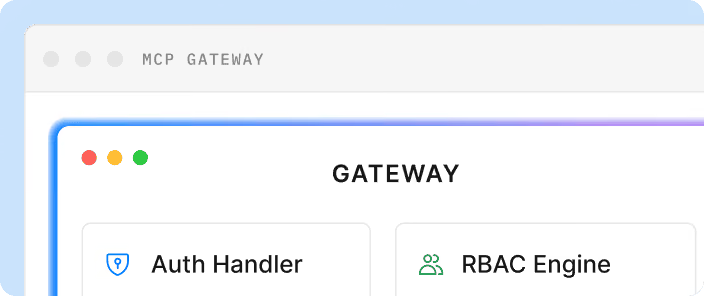
DigitalAPI.ai resolves this chaos by serving as a centralized command center. It provides a federated control plane that sits above your MuleSoft and Apigee instances, allowing you to govern both from a single dashboard.
- Federated control plane: Manage all your APIs, whether they reside in MuleSoft, Apigee, or AWS, from one central dashboard. This eliminates the need to jump between multiple consoles for analytics and governance.
- Commercial leverage: Decouple your control layer from the underlying gateway to avoid vendor lock-in. You gain the flexibility to route traffic to the most cost-effective gateway without rewriting policies.
- Centralized governance: Define security policies once and enforce them globally. Push standard OAuth or rate-limiting rules to both MuleSoft and Apigee simultaneously, ensuring consistent security across your entire estate.
- API-GPT: API-GPT turns APIs into AI-powered agents that execute tasks on demand, so your teams spend less time building workflows and more time driving outcomes. Manual tasks like identifying customers with payment delays, forecasting demand, and finding scheduling conflicts are resolved with a single natural-language prompt.
- Universal API marketplace: Aggregates APIs from all your gateways into a single, branded catalog. Internal and external developers can discover and subscribe to APIs regardless of where they are hosted.
- 360° Analytics: Gain deep visibility into API performance, usage, and errors across every gateway. Track business metrics and operational health in real-time to make data-backed decisions.
Ready to centralize your API strategy?
Book a demo today to see how DigitalAPI.ai can optimize your multi-gateway operations.
Frequently asked questions
1. Can Apigee replace MuleSoft?
No. Apigee lacks the deep integration capabilities of MuleSoft. It cannot natively connect to mainframes or perform complex ETL data transformations (like DataWeave) required for deep system integration.
2. Can MuleSoft replace Apigee?
To an extent, yes. MuleSoft has "API Manager," but it lacks the advanced external-facing features of Apigee, such as robust monetization, sophisticated partner portals, and global edge caching.
3. Is DataWeave proprietary?
Yes. DataWeave is MuleSoft's proprietary expression language for data transformation. It is powerful but creates a learning curve and lock-in, as the code cannot easily be ported to other platforms.
4. Which is better for microservices?
It depends. For the internal "service mesh" layer, lighter gateways are often preferred. However, for exposing microservices to the outside world, Apigee is generally superior due to its lightweight proxy architecture compared to MuleSoft's heavier Java runtime.
Dhayalan Subramanian is Associate Director, Product Growth at DigitalAPI, where he leads go-to-market and product growth for the company’s multi-gateway API management platform. His work focuses on helping large enterprises and mid-market cloud companies consolidate APIs across AWS, Azure, Apigee, Kong, MuleSoft, and other gateways into a single control plane for governance, discovery, monetization, and agent consumption.
Dhayalan brings 14+ years of experience across product strategy, enterprise architecture, and engineering leadership. Earlier in his career, he held senior roles at Encora (as Associate Architect and Technical Manager), Mindtree (Technology Lead), Tech Mahindra (Technical Lead), and Primus Analytics, where he designed integration frameworks and delivered enterprise-grade digital platforms for global customers.
At DigitalAPI, he works directly with platform, integration, and developer experience leaders at Fortune 500 organizations to operationalize unified API catalogs, developer portals, and MCP-ready APIs. He writes regularly on API developer experience, API governance, and AI agent architectures.
One email a fortnight. Worth opening.
A short digest of what we're writing, what we're learning from customers, and the handful of links you'd actually want from us. No tracking pixels.

.avif)