



How to Diagnose a Failing API Portal Before Developer Adoption Drops
The digital economy thrives on seamless connections, and at the heart of many successful digital strategies lies the API developer portal.

TL;DR
1. Proactive diagnosis of an API developer portal is crucial to prevent developer adoption from plummeting.
2. Monitor metrics like registration rates, API key generation, and API call volumes for early warning signs.
3. Poor documentation, difficult search, and lack of code examples are major red flags that deter developers.
4. A clunky user experience, slow loading times, and complex onboarding processes drive developers away.
5. Inactive community forums, high support tickets for basic issues, and unclear feedback channels indicate portal health problems.
6. Discrepancies between the portal and actual API behavior, along with poor version management, erode trust.
7. Regular audits, automated content updates, and a strong focus on developer feedback are vital for a healthy, high-adoption portal.
The digital economy thrives on seamless connections, and at the heart of many successful digital strategies lies the API developer portal. Far from being a mere repository, it's the critical handshake between your organization's digital assets and the external developers, partners, and internal teams who leverage them. When this essential interface starts to falter, the impact isn't always immediately obvious. Adoption doesn't crash overnight; it erodes silently, a slow decline in engagement that only becomes apparent once it's too late. Understanding the subtle indicators of a failing portal before this decline becomes irreversible is not just good practice, it's paramount to maintaining your competitive edge and nurturing a vibrant developer ecosystem.
The Silent Erosion: Why API Developer Portals Underperform
An API developer portal is more than just a website; it's a strategic asset that serves as the primary interface for your APIs. It's where developers discover, learn, integrate, and manage their interaction with your services. Its performance directly impacts developer experience, time-to-market for integrations, and ultimately, the success of your API program. When a portal underperforms, it often signals deeper issues than just a few broken links. It can indicate a disconnect between internal API strategy and external developer needs, or a failure to adapt to evolving technical landscapes.
The challenge lies in detecting this underperformance before it translates into a tangible drop in adoption. Developers are discerning; they quickly abandon portals that are frustrating, outdated, or unreliable. This "silent erosion" means that by the time you see a significant dip in API usage, many developers may have already moved on to alternative solutions. Proactive diagnosis becomes the only viable approach to safeguarding your investment and keeping your developer community engaged.
What is an API Developer Portal, and Why Does it Matter?
An API developer portal is a self-service platform designed to support the entire lifecycle of external and internal API consumption. It typically includes API documentation, code samples, SDKs, tutorials, an API catalog, an interactive console, registration and key management, community forums, and support resources. Its primary goal is to make it as easy as possible for developers to find, understand, test, integrate with, and get support for your APIs.
For businesses, a well-executed developer portal is critical for several reasons:
- Accelerates API Adoption: A good portal reduces friction, making it faster and easier for developers to get started, leading to higher adoption rates.
- Fosters Innovation: By making APIs accessible and easy to use, a portal enables developers to build new applications and services, expanding your ecosystem.
- Reduces Support Costs: Comprehensive documentation and self-service tools empower developers to find answers independently, decreasing the load on your support teams.
- Strengthens Brand & Trust: A professional, user-friendly portal reflects positively on your brand and builds trust within the developer community.
- Enables Scalability: It provides a scalable way to onboard and support thousands of developers without linear increases in operational costs.
When a portal fails to deliver on these promises, the negative consequences ripple throughout the organization, affecting product development, partnerships, and market reach.
.png)
How to Diagnose a Failing API Developer Portal Before Adoption Drops
Diagnosing a failing API developer portal requires a comprehensive approach, combining quantitative data analysis with qualitative user feedback. By looking beyond superficial metrics, you can identify underlying issues that are quietly driving developers away. Here’s a detailed guide to spotting the red flags early.
1. Observing Key Metrics & Analytics
The first line of defense against a failing portal is a robust analytics framework. Data doesn't lie, and consistent monitoring can reveal declining health before developers vocalize their frustrations.
A. Low Developer Registration & Login Rates
A healthy portal should see a steady stream of new registrations and consistent logins from existing users. A drop in these numbers signals that either new developers aren't finding value in your APIs, or existing developers are no longer actively engaging with your platform. This could be due to poor marketing, a difficult registration process, or a perceived lack of value.
- Signs: Declining unique registrations month-over-month, low repeat login rates for existing users, a long time gap between registration and first API call.
- Action: Review your onboarding funnel, marketing channels, and the initial perceived value proposition of your APIs.
B. Decreased API Key Generation
API keys are essential for accessing your services. If fewer keys are being generated, it indicates that developers are not progressing beyond discovery to actual integration. This can stem from complex key generation processes, unclear API usage policies, or a lack of compelling reasons to integrate.
- Signs: Stagnant or declining numbers of new API keys requested, high abandonment rates during the key generation process.
- Action: Simplify the API key request process, ensure clear instructions, and highlight immediate benefits of integration.
C. Stagnant or Declining API Call Volumes
This is perhaps the most direct indicator of falling adoption. If the total number of API calls, or calls per unique developer, is trending downwards, it means fewer applications are being built, or existing applications are being used less. This could be due to performance issues, breaking changes, or developers switching to competitor APIs.
- Signs: Overall API call volume dip, decreased calls from key partners, low growth in calls from new integrations.
- Action: Investigate API performance, reliability, and any recent breaking changes. Gather feedback on alternative solutions developers might be using.
D. High Bounce Rates & Short Session Durations
When developers visit your portal, do they stick around? High bounce rates (developers leaving after viewing only one page) and short session durations suggest that they're not finding what they need quickly, or the content isn't engaging. This often points to poor navigation, irrelevant search results, or unhelpful content.
- Signs: Analytics showing users spending minimal time on key documentation pages, frequent exits from search results pages.
- Action: Improve content organization, search relevance, and ensure a clear information hierarchy.
E. Poor Search Utilization
Developers typically arrive at a portal with a specific task in mind. If your internal search functionality is rarely used, or if analytics show repetitive searches for the same terms without successful outcomes, it indicates a failure in discoverability. Developers might be struggling to find documentation or specific API endpoints.
- Signs: Low percentage of sessions using the search bar, high number of "no results found" for common queries, developers resorting to external search engines (Google) to find your portal's content.
- Action: Enhance search capabilities (fuzzy matching, synonyms), improve content tagging, and analyze search queries to identify content gaps.
2. Assessing Content Quality & Discoverability
Even with robust APIs, poor content will hinder adoption. The quality and accessibility of your documentation are paramount to developer success.
A. Outdated, Incomplete, or Inconsistent Documentation
Nothing frustrates developers more than documentation that doesn't match the actual API behavior. Outdated examples, missing parameters, or conflicting information across different sections erode trust and waste valuable development time. This is a primary driver of adoption decline.
- Signs: Frequent reports of documentation discrepancies, API behavior not matching examples, missing details for critical parameters, lack of clarity on error codes.
- Action: Implement a regular documentation review cycle, automate documentation generation from API specs (e.g., OpenAPI), and ensure all examples are tested and verified.
B. Poor Search Functionality & Tagging
As mentioned in metrics, if developers can't find what they need, the content might as well not exist. Ineffective search and inconsistent tagging make the portal a maze rather than a guide.
- Signs: Developers complaining about difficulty finding specific APIs or endpoints, irrelevant search results, lack of filtering options, inconsistent categorization.
- Action: Invest in a powerful search engine, establish clear tagging conventions, and implement filters for domains, use cases, or API status.
C. Lack of Code Examples & SDKs
Developers learn by doing. Providing readily available code snippets, SDKs in popular languages, and working examples significantly lowers the barrier to entry. Their absence forces developers to write boilerplate code, slowing down integration.
- Signs: High requests for example code, developers sharing their own examples in forums, low usage of interactive API consoles.
- Action: Develop and maintain SDKs for common languages, provide runnable code examples for all endpoints, and ensure interactive "try-it-out" consoles are functional.
D. Absence of Clear Use Cases & Tutorials
Developers often seek to solve a problem, not just use an API. Portals that only list endpoints without explaining how they fit into broader use cases or offering step-by-step tutorials will struggle. Developers need to understand the "why" as much as the "how."
- Signs: Feedback indicating a lack of inspiration or guidance, low engagement with higher-level conceptual content, developers asking for "how-to" guides.
- Action: Create comprehensive tutorials, quickstart guides, and real-world use case examples.
E. API Sprawl & Duplication Without Guidance
In large organizations, API sprawl is common. If your portal lists multiple APIs that serve similar functions without guiding developers on which one to use, it creates confusion and frustration. This indicates a lack of clear API governance reflected in the portal.
- Signs: Developers integrating with outdated or redundant APIs, multiple APIs serving similar functions without clear differentiation or deprecation paths.
- Action: Implement an API catalog to organize and govern APIs, clearly mark deprecated APIs, and provide guidance on preferred versions or alternatives.
3. Evaluating User Experience & Onboarding
The usability of your portal, from the moment a developer lands on it to their first successful API call, is crucial. A clunky or confusing experience can lead to abandonment.
A. Complex Registration & API Key Processes
The initial hurdles should be minimal. If registration involves too many steps, unclear forms, or lengthy approval processes for API keys, developers will simply give up. Time-to-first-call is a critical metric for developer satisfaction.
- Signs: High drop-off rates during registration, frequent support tickets related to account creation or key provisioning, long wait times for API key approval.
- Action: Streamline registration, reduce form fields, automate API key provisioning, and provide clear progress indicators.
B. Unintuitive Navigation & UI Design
A developer portal should be easy to navigate, allowing users to quickly find what they need without extensive searching. A cluttered interface, inconsistent layout, or confusing information architecture are major deterrents.
- Signs: High bounce rates, low engagement with critical sections, user feedback complaining about difficulty finding information, inconsistent UI elements.
- Action: Conduct UX audits, implement clear navigation menus, follow consistent design principles, and perform user testing with target developers.
C. Lack of Self-Service Options
Developers value autonomy. If they constantly need to contact support for routine tasks like managing API keys, viewing usage analytics, or troubleshooting minor issues, the portal isn't serving its purpose effectively. This points to a lack of self-service capabilities.
- Signs: High support ticket volumes for common tasks, developers requesting features that should be self-service.
- Action: Provide dashboards for API key management, usage analytics, billing information, and a comprehensive FAQ section.
D. Poor Performance & Load Times
In an era of instant gratification, slow-loading pages or unresponsive interfaces are deal-breakers. A sluggish portal frustrates developers, leading them to assume that the underlying APIs might also be unreliable.
- Signs: High bounce rates linked to slow page load times (checked via analytics tools), user complaints about portal unresponsiveness.
- Action: Optimize images, minimize scripts, leverage CDNs, and ensure robust hosting infrastructure for your portal.
E. Limited Customization & Branding
For partner portals or internal developer experiences, the ability to customize branding or integrate the portal seamlessly into existing workflows can be important. A generic, unbranded experience can feel impersonal and less trustworthy.
- Signs: Requests for white-labeling or branding options, lack of visual cohesion with the main company website.
- Action: Offer customization options for branding, consider embeddable components, or provide APIs for portal content integration.
4. Analyzing Support & Community Engagement
A thriving developer ecosystem relies on effective support and a strong sense of community. Issues here can quickly lead to developer frustration and abandonment.
A. High Support Ticket Volumes for Basic Queries
If your support team is inundated with questions that should be easily answerable through documentation or FAQs, it's a clear sign your portal content is failing. This indicates a gap in self-service support.
- Signs: Repetitive support tickets asking for basic information or troubleshooting steps, high first-contact resolution rates for common issues.
- Action: Improve documentation clarity, expand the FAQ, create more tutorials, and ensure search effectively surfaces relevant answers.
B. Inactive Community Forums or Channels
A vibrant developer community is a powerful asset. If your forums, Slack channels, or other community platforms are silent, it means developers aren't connecting with each other or your team. This can lead to feelings of isolation and a lack of shared knowledge.
- Signs: Few new posts, no responses to questions, lack of discussion threads, developers migrating to external, unofficial channels.
- Action: Actively moderate and participate in forums, host Q&A sessions, highlight community contributions, and offer incentives for engagement.
C. Slow or Unresponsive Support
When developers do need help, timely and effective support is crucial. Long response times or unhelpful answers will quickly drive developers away, particularly for critical integration issues.
- Signs: High average response times for support tickets, low developer satisfaction scores for support interactions, repeated complaints about support quality.
- Action: Set and meet clear SLAs for support, train support staff on API specifics, and implement robust ticketing systems.
D. Lack of Feedback Mechanisms
If developers can't easily provide feedback on documentation, API design, or portal features, you're missing a vital source of improvement. This can lead to unaddressed frustrations that simmer and eventually boil over.
- Signs: Absence of "Was this helpful?" buttons, no clear "contact us" for feedback, reliance on formal surveys rather than continuous input.
- Action: Implement in-line feedback forms, prominently display contact information, and actively solicit suggestions from your developer community.
5. Reviewing API Lifecycle & Governance Alignment
A portal isn't just about static content; it must accurately reflect the dynamic state of your APIs. Discrepancies here can lead to broken integrations and lost trust.
A. Discrepancies Between Portal & Reality
This is a critical failure point. If the APIs documented on the portal don't match the actual APIs in production (e.g., different endpoints, missing parameters, outdated authentication methods), developers will face immediate integration issues. This points to a lack of automation in documentation sync.
- Signs: Developers reporting API errors that contradict documentation, calls failing because required parameters are missing from documentation, security model described on portal not matching actual implementation.
- Action: Automate documentation generation and syncing with your API gateway and source control. Implement robust testing to ensure documentation accuracy.
B. Unclear Deprecation Policies
APIs evolve, and some will eventually be deprecated. If your portal doesn't clearly communicate deprecation timelines, migration guides, and alternative APIs, developers will be caught off guard, leading to broken applications and frustration.
- Signs: Developers surprised by API deprecations, lack of a clear deprecation policy documented on the portal, absence of versioning or sunsetting information.
- Action: Establish a clear API lifecycle management process, prominently display deprecation notices, provide ample warning periods, and offer migration assistance.
C. Security Vulnerabilities & Compliance Gaps
A portal that poorly handles security (e.g., insecure API key management, insufficient authentication details) or fails to clearly communicate compliance standards can expose both your organization and developers to risks. This quickly erodes trust, especially for enterprise clients.
- Signs: Lack of clear security best practices, inadequate information on OAuth/OpenID Connect flows, absence of compliance certifications or statements.
- Action: Ensure robust security protocols for the portal itself, provide clear guidance on secure API usage, and prominently display compliance and security information.
D. Lack of Version Management Clarity
When APIs have multiple versions, the portal must clearly differentiate them, highlight changes, and guide developers on which version to use. Confusion over versions leads to integration headaches and potential compatibility issues.
- Signs: Developers integrating with incorrect API versions, difficulty finding change logs or version release notes, unclear documentation for different versions.
- Action: Implement clear versioning strategies, provide detailed changelogs, allow easy switching between documentation for different versions, and guide developers on upgrades.
The Hidden Costs of a Neglected Portal
Failing to diagnose and address issues with your API developer portal carries significant, often hidden, costs that can impede your business objectives.
1. Reduced Developer Productivity
When developers struggle with poor documentation, confusing processes, or unreliable APIs, their productivity plummets. This means slower innovation, delayed product launches, and wasted engineering hours, both internally and for your partners.
2. Missed Innovation Opportunities
A healthy portal inspires and enables. A failing one stifles creativity, as developers are less likely to experiment with your APIs or build novel applications if the foundational experience is frustrating. This can lead to your ecosystem stagnating while competitors surge ahead.
3. Damaged Brand Reputation
In the developer community, word spreads fast. A reputation for difficult-to-use APIs or a poorly maintained portal can significantly harm your brand image, making it harder to attract top talent, partners, and customers. This can be a long and costly road to recovery.
4. Increased Operational Overheads
A portal that fails at self-service pushes the burden onto your support and engineering teams. High volumes of basic support tickets, repeated bug reports due to poor documentation, and the need for manual developer onboarding all contribute to increased operational costs and resource drain.
Revitalizing Your Portal: A Path to Higher Adoption
Once you've diagnosed the issues, it's time to act. Revitalizing a failing portal requires a strategic, ongoing commitment to improvement.
1. Prioritize Developer Experience
Put yourself in the developer's shoes. Simplify every touchpoint, from registration to API key management and integration. Invest in intuitive UI/UX, clear navigation, and robust search capabilities. Make the "time to first successful call" as short as possible.
2. Automate Documentation & Sync
Eliminate manual documentation updates. Integrate your portal with your API gateways, version control systems (like Git), and CI/CD pipelines to ensure documentation always reflects the live API state. Use tools that generate documentation directly from OpenAPI/Swagger specifications.
3. Foster Community & Feedback
Actively engage with your developer community. Provide clear channels for feedback, participate in forums, host webinars, and encourage peer-to-peer support. Show developers that their input is valued and acted upon.
4. Invest in Performance & Scalability
Ensure your portal is fast, reliable, and capable of handling increasing traffic. Regular performance testing and optimization are critical to maintaining a positive user experience and ensuring trust in your infrastructure.
5. Align with API Governance
Your portal should be a reflection of your API strategy and governance. Ensure consistency across API design, versioning, security, and deprecation policies. Clearly communicate the API lifecycle to avoid surprises and facilitate smooth transitions.
How DigitalAPI turns around a failing portal?
Most turnarounds start with the same decision. Stop investing in the existing portal surface and move the developer experience layer onto a platform that was built for it. That does not mean replacing your APIs, your gateways, or your existing auth. It means swapping the layer the developer actually sees with one that meets the bar partners now expect. DigitalAPI is built for exactly that.
Here is what changes the day you switch.
- Multi-gateway cataloging on day one: Point DigitalAPI at Kong, Apigee, AWS API Gateway, Azure API Management, MuleSoft, or APISIX (or any combination after an acquisition or migration). Every API surfaces in one unified catalog. The "why are there three portals?" complaint from partners disappears. This is usually the fastest observable win after the switch.
- Persona-based navigation that replaces the flat list: External partners, internal platform teams, and enterprise customers each land on a journey scoped to their use case, with their credentials, their sandbox, and their quick-start. This alone tends to cut median time-to-first-call from days to under an hour.
- In-portal testing with pre-filled payloads and real error examples: Every endpoint ships with a live try-it console, realistic sample values, and specific response examples for success and each failure mode. The "400 Bad Request" that used to generate a support ticket is replaced with the actual cause the API returned.
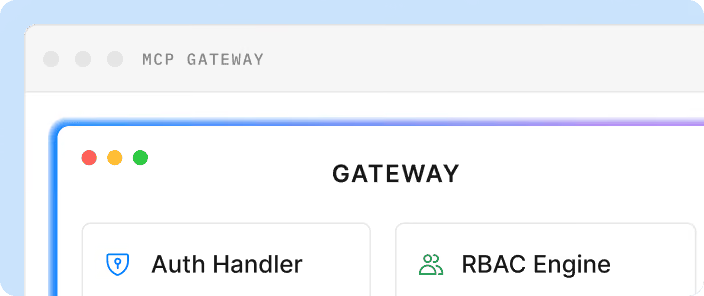
- AI-powered docs and search: AI-generated overviews and error explanations turn the portal into something that answers questions in context, instead of a search box that returns a list of doc pages. For teams already getting AI-agent traffic, the built-in MCP gateway means those same APIs are consumable by agents without a second integration.
- Non-developer content editing: Product, marketing, and technical writing own the overviews and use-case guides through a draft-review-publish workflow. Content stops decaying between releases, which removes one of the three most common root causes of failing portals.
- RBAC, sandbox, and governance out of the box: Role-based visibility separates internal from external APIs automatically. Isolated sandbox credentials provision for every new developer. Automated governance checks catch inconsistent auth and error schemas before they reach partners.
- Analytics that show you exactly where the failure is: Per-API, per-partner usage, error heatmaps, and time-to-first-call broken down by cohort. The diagnostic stops being a guess and becomes a live dashboard.
FAQs
1. What are the top signs of a failing API portal?
Key indicators include declining developer registrations and API key generations, stagnant API call volumes, high bounce rates on documentation pages, frequent support tickets for basic queries, and outdated or inconsistent documentation that doesn't match live APIs.
2. How often should I review my API portal's performance?
You should monitor your portal's key metrics (registrations, API calls, session duration, search queries) on a weekly or bi-weekly basis for trends. A more comprehensive review, including content audit and user feedback analysis, should be conducted at least quarterly or semi-annually.
3. What role does documentation play in portal adoption?
Documentation is the cornerstone of API adoption. Clear, accurate, and comprehensive documentation, complete with code examples, SDKs, and tutorials, directly correlates with faster integration times and higher developer satisfaction. Poor documentation is a primary reason for portal abandonment.
4. Can a good developer portal reduce support costs?
Absolutely. By providing excellent self-service capabilities—comprehensive FAQs, interactive documentation, detailed troubleshooting guides, and usage analytics—a well-designed developer portal empowers developers to resolve issues independently, significantly reducing the volume of basic support tickets and freeing up your support team for more complex issues.
5. What's the difference between an API portal and an API catalog?
An API portal is a comprehensive platform for developers to discover, learn, integrate, and manage APIs, offering documentation, tools, community features, and more. An API catalog, while often integrated into a portal, is specifically a centralized, structured inventory of all your APIs, providing metadata, ownership, lifecycle status, and a single source of truth for your API estate. A catalog helps organize the APIs *within* the portal.
Dhayalan Subramanian is Associate Director, Product Growth at DigitalAPI, where he leads go-to-market and product growth for the company’s multi-gateway API management platform. His work focuses on helping large enterprises and mid-market cloud companies consolidate APIs across AWS, Azure, Apigee, Kong, MuleSoft, and other gateways into a single control plane for governance, discovery, monetization, and agent consumption.
Dhayalan brings 14+ years of experience across product strategy, enterprise architecture, and engineering leadership. Earlier in his career, he held senior roles at Encora (as Associate Architect and Technical Manager), Mindtree (Technology Lead), Tech Mahindra (Technical Lead), and Primus Analytics, where he designed integration frameworks and delivered enterprise-grade digital platforms for global customers.
At DigitalAPI, he works directly with platform, integration, and developer experience leaders at Fortune 500 organizations to operationalize unified API catalogs, developer portals, and MCP-ready APIs. He writes regularly on API developer experience, API governance, and AI agent architectures.
One email a fortnight. Worth opening.
A short digest of what we're writing, what we're learning from customers, and the handful of links you'd actually want from us. No tracking pixels.

.avif)