



Your Brand, Your Portal: Get your White Labelled Drupal Portal!
A white label solution is a product or service produced by one company that other companies rebrand to make it appear as if they had created it.

TL;DR
1. White label Drupal portals provide fully branded digital experiences without the burden of ground-up development.
2. They harness Drupal's enterprise-grade capabilities – security, scalability, and robust content management – in a pre-configured, customizable package.
3. Key advantages include rapid deployment, significant cost savings, consistent brand representation across multiple entities, and reduced ongoing maintenance.
4. Essential features often involve multi-tenancy, granular user management, flexible theming, and seamless integration capabilities.
5. These solutions are ideal for agencies, SaaS companies, and large organizations needing to deploy multiple, distinct, branded digital platforms efficiently.
Transform your digital strategy. Explore White Label Drupal Portal by DigitalAPI!
Crafting a unique digital footprint is paramount for any organization aiming to connect deeply with its audience. Yet, building bespoke portals for every distinct brand, client, or internal division can quickly become an exhaustive and resource-heavy endeavor. The allure of a fully customized experience often collides with the realities of budget, timeline, and development complexity. This is precisely where a white labelled Drupal portal emerges as a strategic game-changer, offering the best of both worlds: branded autonomy combined with operational efficiency. It’s about empowering your brand or your clients' brands with powerful digital platforms, all while streamlining your development pipeline and maintaining a unified underlying architecture.
Understanding White Label Drupal Portals
In the competitive digital landscape, organizations are constantly seeking ways to deliver rich, engaging, and branded experiences to their users, partners, or customers. However, the path to achieving this can be fraught with challenges, particularly when multiple distinct entities require their own unique digital presence.
This is where the concept of a white labelled Drupal portal becomes not just convenient, but essential. It represents a powerful solution for those who need to deploy branded digital platforms efficiently and cost-effectively.
What is a White Label Solution?
A white label solution is a product or service produced by one company that other companies rebrand to make it appear as if they had created it. Think of it as a generic, high-quality product that comes without a label, ready for you to put your own brand's sticker on it. In the digital realm, this typically refers to software or platforms that are developed by a vendor but are designed to be fully customizable in terms of branding, user interface, and sometimes even functionality, by the purchasing company.
The primary goal is to allow businesses to offer a robust, fully-featured product or service under their own brand without having to invest in the research, development, and maintenance from scratch. This saves immense amounts of time, money, and resources, allowing companies to focus on their core competencies while still expanding their service offerings or internal digital capabilities.
For example, a digital marketing agency might offer a white labelled Drupal portal to their clients. Each client gets a distinct, branded portal that looks and feels like it was custom-built for them, while the agency benefits from leveraging a pre-built, proven platform, customizing it quickly, and managing it efficiently for multiple clients.
Why Drupal for White Labeling?
Drupal stands out as an exceptional choice for white label solutions, particularly for portals. Its strengths align perfectly with the demands of creating multiple, customizable, yet centrally managed digital experiences:
- Open Source Flexibility: As an open-source CMS, Drupal offers unparalleled flexibility. Developers have full access to the code, allowing for deep customization at every level – from the database schema to the front-end user experience. This means a white label Drupal portal can be tailored precisely to the unique branding and functional requirements of each tenant or sub-brand.
- Robust and Scalable Architecture: Drupal is built for enterprise-level applications. Its modular architecture means it can handle complex data structures, high traffic volumes, and a vast array of functionalities without compromising performance. This scalability is critical when you're managing multiple portals from a single underlying infrastructure, ensuring that each branded instance can grow and evolve independently.
- Powerful Content Management: Drupal's content management capabilities are second to none. It offers flexible content types, advanced taxonomies, and sophisticated content workflows. This empowers each white label tenant to manage their specific content, user roles, and permissions with ease, maintaining consistency while allowing for brand-specific nuances.
- Security First: With a dedicated security team and a proactive approach to vulnerability management, Drupal is one of the most secure CMS platforms available. For white labelled Drupal portals, where data separation and security are paramount across different tenants, Drupal's inherent security features provide peace of mind.
- Extensive Module Ecosystem: The Drupal community has developed thousands of modules that extend its functionality. This rich ecosystem means that common features required by portals – such as e-commerce integration, CRM connectivity, advanced search, user authentication, and multilingual support – can often be added with existing modules, significantly reducing development time and cost for white label instances.
- Multi-Site and Multi-Tenancy Capabilities: Drupal inherently supports multi-site configurations, allowing multiple websites to run from a single Drupal codebase. This capability is foundational for white label solutions, enabling efficient management and updates across numerous branded portals while ensuring each maintains its distinct identity and data separation.
By leveraging Drupal, companies offering white label solutions can promise their clients or internal stakeholders a powerful, secure, scalable, and highly customizable digital platform, all while managing the underlying technology stack efficiently.
.png)
Key Features of a Robust White Label Drupal Portal
To truly deliver on the promise of efficiency and customizability, a white labelled Drupal portal must come equipped with a specific set of features that enable flexible branding, secure data separation, and powerful content delivery across multiple instances. These are the cornerstones of a successful white label implementation:
1. Multi-Tenancy Architecture
This is perhaps the most critical feature, enabling the core concept of white labeling. A multi-tenancy architecture allows a single instance of the Drupal application (and its underlying infrastructure) to serve multiple distinct customers or organizations (tenants), each with its own branded portal.
- Data Isolation: Ensures that data from one tenant is strictly separated and inaccessible to other tenants, crucial for security and privacy.
- Configuration Isolation: Allows each tenant to have unique configurations, settings, and customizations without affecting others.
- Shared Codebase: All tenants run on the same core Drupal codebase, simplifying updates and maintenance for the platform provider.
- Domain Mapping: Enables each tenant's portal to be accessible via its own distinct domain name (e.g., client1.com, brandX.net), creating a fully branded experience.
2. Granular User and Role Management
Different tenants will have different user bases and varying access requirements. A robust white label Drupal portal needs sophisticated user management.
- Tenant-Specific User Management: Each tenant can manage their own users, roles, and permissions independent of other tenants.
- Flexible Role-Based Access Control (RBAC): Allows the creation of custom roles with specific privileges within each portal (e.g., content editor, administrator, basic user).
- Single Sign-On (SSO) Capabilities: Integration with external identity providers for seamless and secure user authentication across multiple applications relevant to a specific tenant.
3. Flexible Content Management & Personalization
Content is king, and each branded portal will need its unique content strategy and the ability to deliver personalized experiences.
- Custom Content Types: Ability for each tenant to define and manage their specific content types (e.g., news articles, products, events) within their portal.
- Advanced Taxonomy: Flexible categorization of content to improve organization and searchability within each tenant's site.
- Content Workflows: Tools for managing content creation, review, and publishing processes specific to each portal.
- Personalization Features: Options to deliver tailored content, features, or advertisements based on user behavior, roles, or demographics within a tenant's portal.
4. Seamless Integrations (CRM, ERP, Payment Gateways)
Digital portals rarely exist in a vacuum. Integration with other business systems is crucial for functionality and efficiency.
- API-First Architecture: Drupal's API-first approach makes it easy to integrate with a wide range of third-party systems.
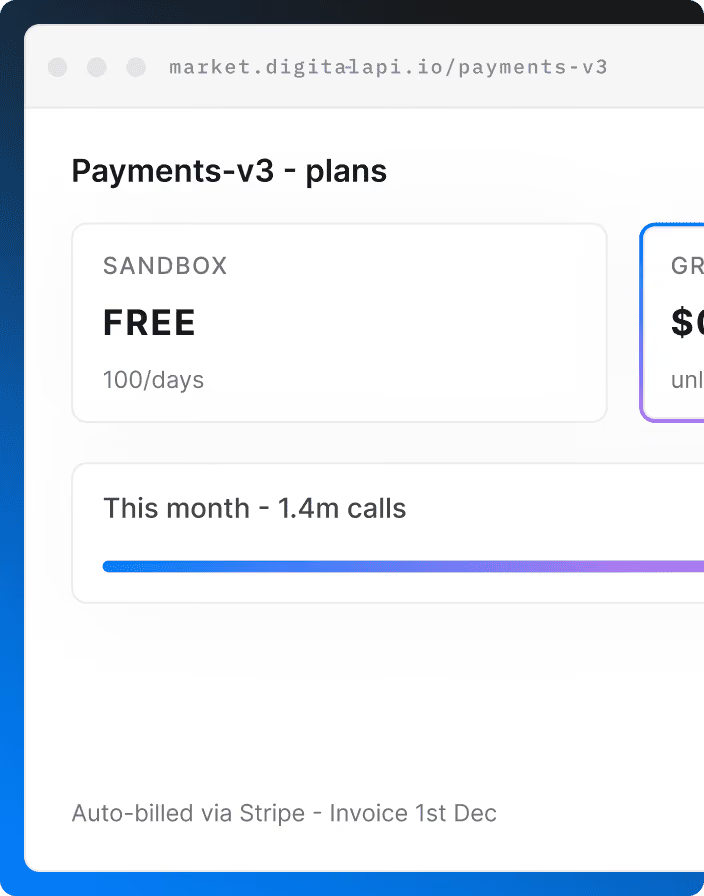
- Pre-built Connectors: Availability of modules or custom development capabilities to integrate with popular CRM (e.g., Salesforce), ERP (e.g., SAP), marketing automation, and payment gateway (e.g., Stripe, PayPal) solutions, configurable per tenant.
- Webhooks and Event-Driven Architecture: Support for real-time data exchange and workflow automation with external systems.
5. Advanced Theming and Branding Options
This is where the "white label" aspect truly shines, allowing each portal to reflect its unique brand identity.
- Theme Inheritance: A base theme can be provided, with each tenant applying their unique sub-theme or branding overrides.
- Configurable Branding Elements: Easy-to-use interfaces for uploading logos, changing color schemes, adjusting fonts, and customizing navigation elements without touching code.
- CSS/JavaScript Overrides: Ability for advanced customization through custom CSS and JavaScript files specific to each tenant.
6. Search and Navigation Capabilities
Users expect intuitive ways to find information within any portal.
- Powerful Search Functionality: Integration with search solutions (e.g., Apache Solr, ElasticSearch) to provide fast and relevant search results across a tenant's content.
- Configurable Menus and Navigation: Each tenant can define its own primary and secondary navigation menus, footers, and sidebars.
7. Performance and Security Built-in
These are non-negotiable for any enterprise-grade solution, especially one serving multiple entities.
- Optimized Caching Mechanisms: Drupal's robust caching system (internal and external like Varnish, Redis) ensures fast page loads and a smooth user experience for all tenants.
- SSL/TLS Support: Ensures secure communication for all branded portals.
- Regular Security Audits & Updates: The underlying Drupal platform benefits from continuous security scrutiny and updates, which are then applied across all white label instances.
- Role-Based Security: Ensures users only access content and features they are authorized for within their specific portal.
By offering these capabilities, a white labelled Drupal portal empowers businesses to rapidly deploy, manage, and scale a diverse portfolio of branded digital experiences, leveraging a single, powerful, and secure foundation.
Navigating the Landscape: Choosing the Right White Label Drupal Partner
The success of your white labelled Drupal portal hinges significantly on the expertise and capabilities of the partner you choose to develop or implement it. This isn't just about finding a Drupal developer; it's about finding a strategic ally who understands the nuances of multi-tenancy, scalability, and brand differentiation. Here's what to look for:
Experience and Expertise in Drupal & White Label Solutions
- Proven Drupal Track Record: Look for a partner with extensive experience in enterprise-level Drupal development, showcasing complex projects, module development, and core contributions.
- Multi-Tenancy Experience: Crucially, inquire about their experience specifically with multi-tenant architectures and white label implementations. Ask for case studies or examples where they've successfully deployed similar solutions.
- Team Expertise: Assess the technical skills of their team, including architects, developers, UI/UX designers, and quality assurance specialists who understand the specific challenges of shared platforms.
Customization Capabilities
A white label solution needs to be flexible enough to accommodate unique branding and functional requirements for each tenant.
- Deep Theming Expertise: Can they create a flexible base theme and efficient sub-theming strategies that allow for distinct branding without duplicating code?
- Module Development & Integration: Do they have the capacity to develop custom modules for unique functionalities or integrate seamlessly with third-party systems that your tenants might require?
- Configuration Management: How do they handle configuration management to ensure that customizations for one tenant don't inadvertently affect others?
Support and Documentation
Post-launch support and clear documentation are vital for the long-term success and manageability of your white label solution.
- Comprehensive Support Packages: What kind of ongoing support do they offer (e.g., 24/7, tiered support, SLAs)? This is critical for maintaining uptime and addressing issues across multiple live portals.
- Clear Documentation: Do they provide thorough documentation for both the platform administrators (on managing the core solution) and for the individual tenant administrators (on managing their specific portal)?
- Training: Do they offer training programs for your team or your clients on how to effectively use and manage their white label portals?
Security Practices
With multiple brands and potentially sensitive data residing on a shared platform, security cannot be an afterthought.
- Security Audits & Best Practices: Inquire about their security development lifecycle, penetration testing procedures, and adherence to Drupal security best practices.
- Data Isolation Strategies: How do they ensure strict data isolation between tenants, adhering to privacy regulations relevant to your industry?
- Compliance Knowledge: Do they have experience with relevant compliance standards (e.g., GDPR, HIPAA, WCAG) if applicable to your industry or client base?
How DigitalAPI delivers a white-label portal without the Drupal build?
Most teams don't want a Drupal project. They want a branded developer portal live on their own domain, with their APIs, their logo, their colors, running securely at scale. Drupal is one path there. DigitalAPI is the faster one.
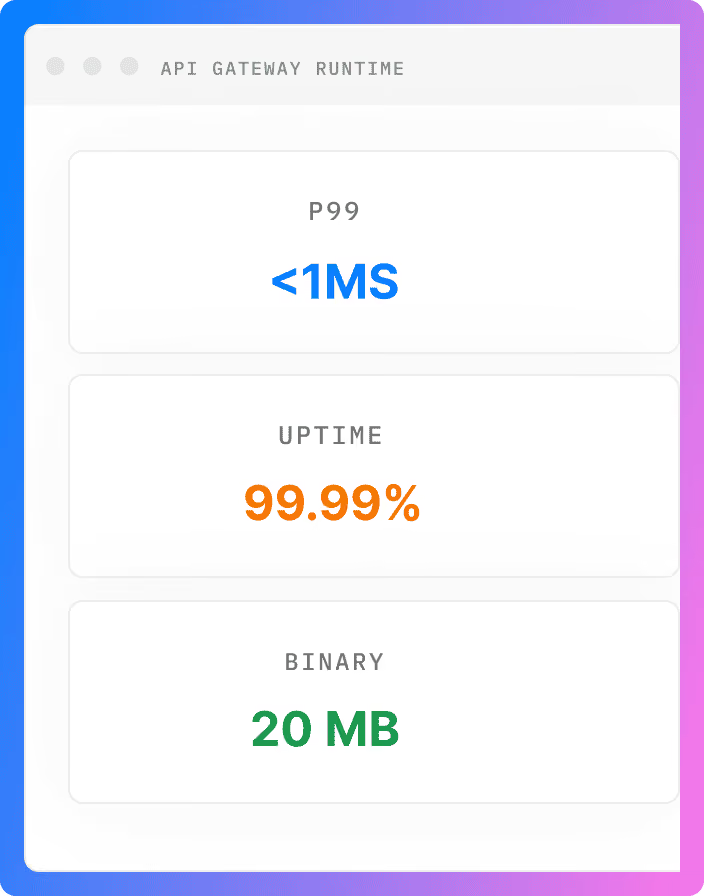
DigitalAPI's White-Labelled Developer Portal is a productized platform that ships the white-label outcome without a 3 to 6 month build. Tenants go live in days, not months, on your domain, with your brand, and with every enterprise control a security team expects from day one.
Why platform, banking, and SaaS teams choose DigitalAPI over a custom Drupal build:
- Multi-gateway API aggregation out of the box: Apigee, Kong, AWS API Gateway, Azure APIM, MuleSoft, APISIX, and custom gateways unified into one searchable catalog per tenant.
- AI-powered documentation and search: OpenAPI and AsyncAPI specs render as always-current interactive docs, with an AI-powered search (API-GPT) that lets developers find APIs in plain English. No stale Drupal content types, no manual doc migrations.
- Built-in testing console and sandbox: A Postman-like interface lives inside every branded portal, with pre-filled auth tokens, request history, and isolated sandbox environments, so partners and internal teams test without leaving the portal or spinning up local infra.
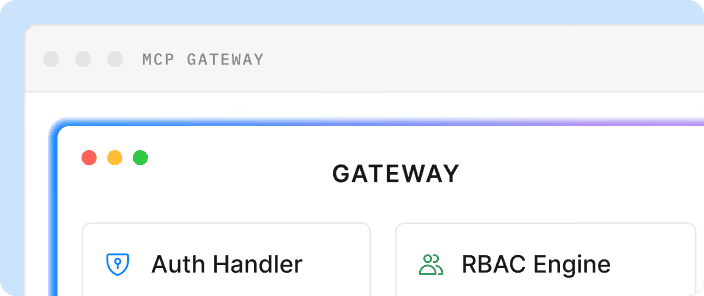
- RBAC, SSO, and governance by default: SSO (SAML, OIDC), SCIM JIT provisioning, custom roles, immutable audit logs, SIEM export, and per-tenant data residency (EU, US, APAC). No enterprise-tier upgrade, no professional services engagement to turn these on.
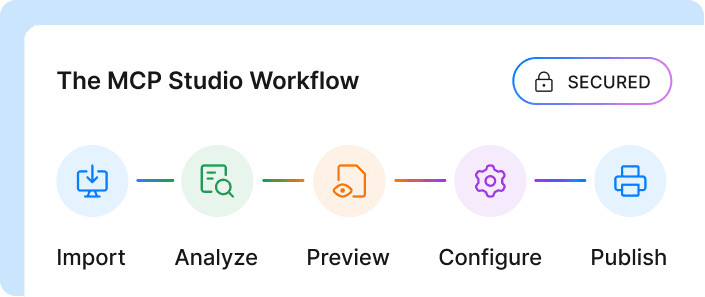
- Agent-ready, MCP-native: Every cataloged API can be exposed as an MCP tool with one click, with OAuth M2M flows and per-agent scoping. AI agents consume your APIs the same way human developers do, with governance intact.
- No-code branding and CMS: Customized design and portal with your logo, palette, typography, and layouts, plus a rich-text CMS simple enough for product or partner teams to run without engineering tickets.
The timeline difference is the easiest way to frame it. A custom Drupal white-label portal is a 3 to 6 month project with frontend devs, a design agency, hosting, and recurring maintenance. DigitalAPI goes live in 3 days: Day 1 connect gateways and brand assets, Day 2 customize and point your custom domain, Day 3 invite developers and go live.
FAQs
1. What is a white label Drupal portal?
A white labelled Drupal portal is a pre-developed, customizable digital platform built on Drupal that can be rebranded and deployed for multiple different clients, brands, or internal departments. It allows you to offer powerful, feature-rich portals under your own or a client's brand name without having to build each one from scratch, leveraging a single underlying Drupal codebase.
2. What are the main benefits of using a white label Drupal portal?
The primary benefits include a significantly faster time-to-market for new portals, substantial cost savings by avoiding redundant development, consistent brand representation across multiple entities, and a reduced burden of ongoing development and maintenance. It also leverages Drupal's inherent strengths in security, scalability, and robust content management.
3. Can I fully customize the branding of a white label Drupal portal?
Yes, extensive branding customization is a core feature of a white labelled Drupal portal. While the underlying functional framework is shared, each portal can have its unique logo, color scheme, typography, layout, and visual design elements to perfectly match the specific brand's identity. This is often achieved through flexible theming layers and configuration options.
4. Is Drupal scalable for managing multiple white label portals?
Absolutely. Drupal is renowned for its enterprise-grade scalability. Its modular architecture, robust caching, and multi-site capabilities make it an ideal foundation for managing numerous white label portals, each potentially serving a large user base with varying content and functional requirements, all from a single, efficiently managed codebase.
5. How does a white label Drupal portal save costs?
Cost savings come from several areas: avoiding the need for individual ground-up development for each portal, reducing ongoing maintenance by centralizing code updates and security patches, leveraging Drupal's open-source nature (no licensing fees), and optimizing development resource allocation. The initial investment in the core white label platform is spread across all subsequently deployed branded portals.
Dhayalan Subramanian is Associate Director, Product Growth at DigitalAPI, where he leads go-to-market and product growth for the company’s multi-gateway API management platform. His work focuses on helping large enterprises and mid-market cloud companies consolidate APIs across AWS, Azure, Apigee, Kong, MuleSoft, and other gateways into a single control plane for governance, discovery, monetization, and agent consumption.
Dhayalan brings 14+ years of experience across product strategy, enterprise architecture, and engineering leadership. Earlier in his career, he held senior roles at Encora (as Associate Architect and Technical Manager), Mindtree (Technology Lead), Tech Mahindra (Technical Lead), and Primus Analytics, where he designed integration frameworks and delivered enterprise-grade digital platforms for global customers.
At DigitalAPI, he works directly with platform, integration, and developer experience leaders at Fortune 500 organizations to operationalize unified API catalogs, developer portals, and MCP-ready APIs. He writes regularly on API developer experience, API governance, and AI agent architectures.

One email a fortnight. Worth opening.
A short digest of what we're writing, what we're learning from customers, and the handful of links you'd actually want from us. No tracking pixels.

.avif)