



The Real Cost of Apigee (And How to Avoid the "Google Tax")
To understand how Apigee pricing behaves in real deployments, it helps to look at how traffic is classified inside the gateway rather than focusing only on per-call rates.


Apigee pricing runs across three models. The evaluation tier gives you 60 days free. Pay-as-you-go charges per environment per region, per API call, and per proxy deployment, with Standard proxies at $20 per million calls and Extensible proxies at $100 per million calls. Subscription tiers start at roughly $2,500 per month for Standard and scale to $8,000 to $25,000 per month for Enterprise depending on call volume and add-ons.
That gap between headline and invoice is where most teams get caught.
TL;DR
1. Apigee pricing combines fixed environment fees with proxy-based usage costs. The invoice total depends on environment type, proxy type, number of regions, and add-on selection.
2. Standard and Extensible proxies are billed at a 5x price difference. Adding a single extensible policy to any proxy moves every call on that proxy to the higher rate. That switch is binary, not graduated.
3. Cloud charges including data egress, VPC peering, NAT gateway fees, and Google Cloud support contracts add to the total spend. These do not appear in the Apigee pricing page.
4. Apigee Edge reached end-of-life in March 2025. All current deployments run on Apigee X.
5. DigitalAPI helps retain Apigee for high-value external partner traffic while routing internal high-volume, low-complexity APIs through a lower-cost gateway, removing the overhead on every internal call.
What Apigee Actually Charges: The Three Pricing Models
Apigee offers three pricing models. The right one depends on where the API programme is in its lifecycle and whether traffic volumes are predictable.
Evaluation: 60 days, no cost
New Apigee customers get a 60-day free evaluation with no upfront commitment. The evaluation organisation is feature-limited compared to paid tiers but gives teams enough to test proxy configuration, policy enforcement, and basic traffic management.
The evaluation period is useful for validating whether Apigee's policy engine fits the team's architecture. It does not replicate the cost behaviour of production deployments, so teams should model production costs separately before committing.
Pay-as-you-go: variable, environment-first billing
Pay-as-you-go is Apigee's entry point into production. The model works well for teams starting with low-volume, high-value APIs. At scale, the per-call charges and environment fees compound quickly.
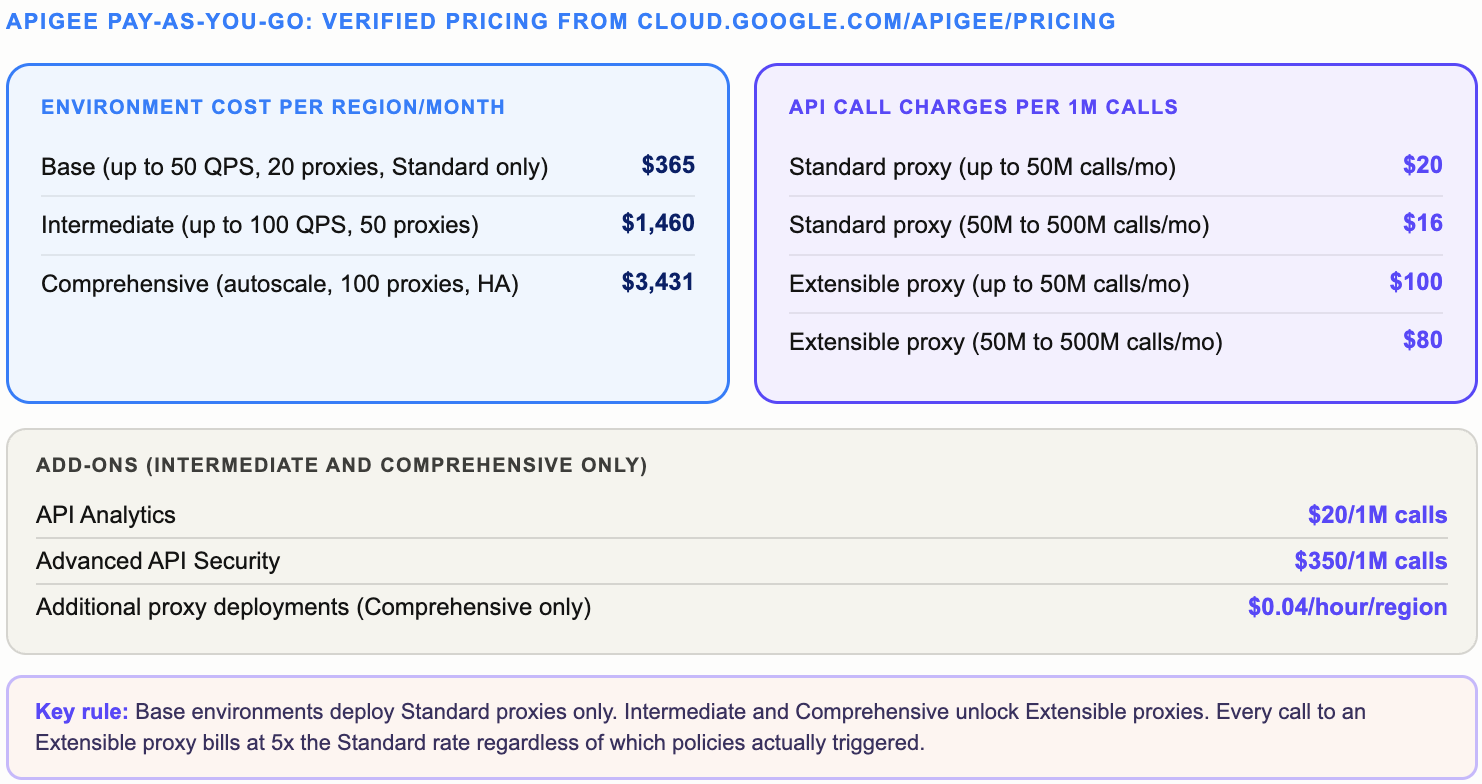
The environment charge is the fixed cost that applies regardless of traffic. A team running one Intermediate environment in a single region pays $1,460 per month before a single API call is processed. Add a second region for redundancy and that base charge doubles to $2,920. The API call charges sit on top of this.
Subscription tiers: predictable volume, negotiated pricing
Subscription is Apigee's enterprise model. Google does not publish subscription prices on the pricing page. Tiers are negotiated based on expected call volume, environment count, and add-on requirements.
Based on available market data, the Standard subscription tier starts at approximately $500 per month with 15 million included API calls per month. Enterprise pricing floors around $2,500 per month. Large enterprises with multi-region deployments, high call volumes, and advanced security add-ons typically pay $8,000 to $25,000 per month.
Subscription removes the pay-as-you-go environment hourly charges and replaces them with a fixed monthly or annual entitlement. Teams with predictable, high-volume traffic almost always find subscription cheaper than pay-as-you-go above a certain volume threshold. The challenge is modelling that threshold accurately before committing.
If Apigee's environment and overage charges are creating budget uncertainty, DigitalAPI routes internal traffic to a lower-cost gateway.
Run the numbers on your setupThe Standard vs Extensible Proxy Split: Where Most Cost Surprises Come From
The biggest hidden driver in Apigee's pricing model is not the environment charge. It is the binary pricing gap between Standard and Extensible proxies.
Standard proxies run a lightweight policy subset. They are designed for simple pass-through, authentication, and rate limiting scenarios. Extensible proxies give access to the full Apigee policy engine: JavaScript callouts, service callouts, message logging, SOAP to REST transformation, and any policy that requires custom logic or external service calls.
The critical distinction: if any extensible policy is applied to a proxy, every single call to that proxy bills at the Extensible rate. There is no partial billing. One JavaScript policy on a proxy that handles 10 million calls per month moves every one of those calls from $20 per million to $100 per million.
Common extensible policies that trigger the higher rate include Service Callouts, Message Logging to external systems like Splunk or Datadog, JavaScript policies, and complex mediation flows. Teams that add these policies without realising the billing implication see a 5x cost jump appear in the next billing cycle.
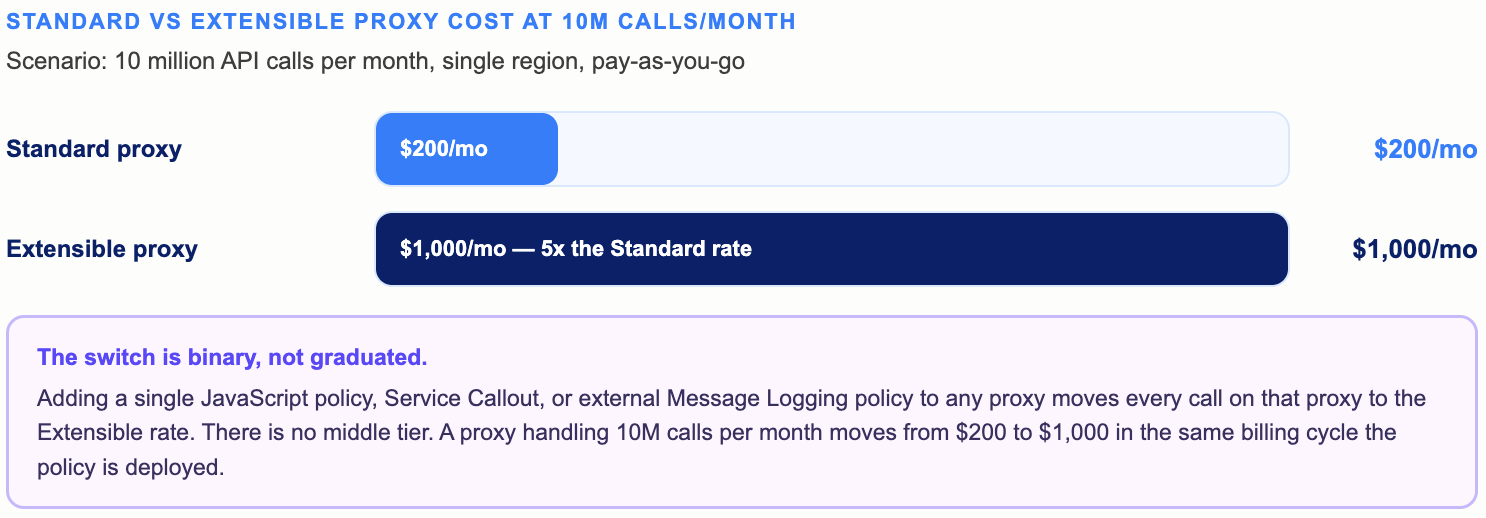
The proxies that most commonly trigger the Extensible rate in production are internal APIs that started as Standard proxies and had logging, monitoring, or transformation policies added incrementally. Each policy addition seemed minor at the time. The billing impact only becomes visible at the end of the month.
Auditing the proxy policy list before deployment is the most effective single action for controlling Apigee costs. If a proxy does not need the full policy engine, keeping it Standard saves 80 percent of the per-call cost at that proxy.
The Additional Costs That Surface After the Contract
Environment and proxy charges are the visible part of the Apigee cost model. Several additional cost lines appear once the deployment goes live that are not listed on the Apigee pricing page.
Data egress and network fees
Google charges for data leaving its network. Every API call that serves a mobile application, a third-party partner, or an on-premises system sends data out of Google Cloud infrastructure. For APIs that return large payloads, data egress becomes a meaningful cost line. The charge depends on destination, volume, and Google Cloud's current networking pricing, which is separate from the Apigee pricing page.
VPC peering charges
Apigee requires peering with your Virtual Private Cloud. Depending on network topology, costs for VPC peering apply. Teams that run backends in the same Google Cloud project as Apigee may avoid some of these charges. Teams with backends in separate projects, other cloud providers, or on-premises infrastructure incur VPC peering charges on every API call that crosses those boundaries.
NAT gateway fees
Apigee relies on NAT Gateways for outbound internet access when calling external services or APIs. Each outbound request flows through this layer, adding per-hour and per-GB charges. APIs that call external services as part of their flow, which most Service Callout policies do, trigger NAT gateway charges in addition to the Extensible proxy rate.
API Analytics as an add-on
API Analytics is not included in the pay-as-you-go base price for most environment types. API Analytics provides built-in or custom dashboards to investigate spikes, improve performance, and identify improvement opportunities by analysing critical information from API traffic. It is available for purchase in Intermediate or Comprehensive environments only, at $20 per million API calls.
For teams that need runtime visibility into their API programme, Analytics is not optional. Adding it to a programme processing 50 million calls per month adds $1,000 per month to the invoice.
Advanced API Security as an add-on
Advanced API Security enables you to protect APIs from misconfigurations, malicious bot attacks, and critical abuses. It is available for purchase in Intermediate or Comprehensive environments only at $350 per million API calls.
At $350 per million calls, Advanced API Security is one of the most expensive add-ons in the Apigee model. Teams running a security-sensitive API programme with 10 million calls per month pay $3,500 per month for this capability alone, on top of the environment charge and the base call rate.
Google Cloud support contracts
Apigee runs on Google Cloud infrastructure. Production API programmes typically require a Google Cloud support contract to get timely responses to incidents. Enhanced Support starts at $150 per month. Premium Support pricing scales with monthly usage and can run into thousands of dollars per month for large deployments.
Apigee vs The Market
| Capability | Apigee | Kong Konnect | AWS API GW | DigitalAPI + Apigee |
|---|---|---|---|---|
| Policy Engine Depth | ✓ | ✓ | ✕ | ✓ |
| Predictable Cost at Scale | ✕ | ✕ | ✕ | ✓ |
| Self-Serve Developer Portal | Basic | Kong-Locked | ✕ | ✓ |
| Multi-Gateway Catalogue | ✕ | ✕ | ✕ | ✓ |
| Partner Onboarding Workflows | ✕ | ✕ | ✕ | ✓ |
| MCP and AI Agent Readiness | ✕ | ✕ | ✕ | ✓ |
Apigee vs Kong Konnect
Kong Konnect also runs a hybrid per-request model on the Plus tier, with $200 per additional million requests and a 10 million monthly cap before Enterprise is required. The two platforms have comparable per-call costs at low to moderate volumes. The differentiation is architectural: Kong's plugin ecosystem handles traffic management at high performance, while Apigee's policy engine goes deeper on API transformation, mediation, and monetization.
Teams choosing between Apigee and Kong are typically making a decision about policy depth versus plugin breadth. Apigee wins for complex mediation and monetization scenarios. Kong wins for teams that need flexibility and a large plugin ecosystem with lower configuration overhead.
Apigee vs AWS API Gateway
AWS API Gateway runs at approximately $3.50 per million requests for the HTTP API and $3.50 per million for the REST API. At equivalent call volumes, AWS API Gateway is dramatically cheaper than Apigee's Extensible proxy rate. The trade-off is depth: AWS API Gateway does not have Apigee's policy engine, mediation capabilities, or API product management features.
For teams running simple Lambda-backed APIs within the AWS ecosystem, AWS API Gateway is the obvious choice on cost. For teams that need Apigee's policy depth, the premium is the cost of that capability.
Apigee and DigitalAPI: keeping Apigee where it earns its cost
The DigitalAPI positioning on Apigee is different from the gateway comparisons above. DigitalAPI analyses traffic patterns to separate high-volume, low-complexity internal APIs from premium external APIs. Internal traffic is routed to Arelio API Gateway while Apigee is retained for partners, optimising cost without disrupting existing integrations.
This is the right approach for organisations that genuinely need Apigee's policy depth for external partner APIs but are also running internal microservice traffic through Apigee because it was already deployed. Routing internal traffic to a lower-cost gateway does not remove Apigee's governance capability for the external programme. It removes the Extensible proxy billing on calls that do not need it.
DigitalAPI's API governance layer applies consistent security, authentication, and policy enforcement across both Apigee and the lower-cost gateway from a unified control plane. The cost drops. The governance coverage stays.
Five Ways to Reduce Apigee Costs Without Reducing Capability
The following cost reduction levers apply to both pay-as-you-go and subscription deployments. None of them require removing Apigee from the architecture.
1. Audit proxies for extensible policy usage before each deployment:
A proxy that handles one million calls per month costs $80 less per month as a Standard proxy than an Extensible proxy. Across twenty proxies, that gap compounds. Review the policy chain of every proxy before deployment and confirm that extensible policies are genuinely needed.
2. Right-size environments to actual traffic requirements:
The Intermediate environment at $1,460 per month is appropriate for most production workloads. Teams that provision Comprehensive environments for redundancy before traffic volumes justify it carry the $3,431 per month charge without the full benefit. Start at Intermediate with the option to upgrade, rather than starting at Comprehensive.
3. Separate internal and external API traffic:
High-volume internal APIs, microservice calls, and service-to-service traffic do not require the full Apigee policy engine. Routing this traffic through a lower-cost gateway while keeping Apigee for external partner APIs reduces the total call volume on Apigee without affecting the external programme. DigitalAPI's API management platform connects both gateways into one unified control plane.
4. Evaluate add-ons against actual usage:
API Analytics at $20 per million calls and Advanced API Security at $350 per million calls are significant cost multipliers at volume. Assess whether the built-in analytics in your observability stack already covers what you need before purchasing these add-ons at the per-call rate.
5. Model multi-region costs before adding regions:
Every additional region multiplies the environment charge. Adding a second region to a Comprehensive environment adds $3,431 per month. Validate that the latency and redundancy benefits justify the cost before provisioning regional deployments.
Frequently Asked Questions
1. What is Apigee pricing?
Apigee pricing has three models: free evaluation, pay-as-you-go, and subscription.
Pay-as-you-go charges per environment per region per month (Base at $365, Intermediate at $1,460, Comprehensive at $3,431) plus per API call (Standard proxies at $20 per million, Extensible proxies at $100 per million). Subscription tiers start around $500 per month for Standard and scale to $25,000 or more per month for large Enterprise deployments.
2. What is the difference between Standard and Extensible Apigee proxies?
Standard proxies cost $20 per million calls. Extensible proxies cost $100 per million calls.
The difference is policy access. Standard proxies support a lightweight subset of Apigee's policies. Extensible proxies support the full policy engine including JavaScript callouts, Service Callouts, and complex mediation. The switch is binary: any extensible policy on a proxy moves every call on that proxy to the Extensible rate for the entire billing cycle.
3. What is the Google Tax in Apigee pricing?
The Google Tax refers to additional Google Cloud infrastructure charges that add to the Apigee licence cost.
These include data egress fees when API responses leave Google's network, VPC peering charges when backends run in separate projects or other clouds, NAT gateway fees for proxies that call external services, and Google Cloud support contracts required for production SLAs. These charges do not appear on the Apigee pricing page and are often underestimated during procurement.
4. Is Apigee Edge still available?
No. Apigee Edge reached end-of-life in March 2025. All current deployments are on Apigee X, which runs natively on Google Cloud infrastructure and integrates with Cloud Logging, Cloud Monitoring, and Cloud Armor. If pricing guides mention Apigee Edge Microgateway or features that differ from what appears in the Google Cloud console, they are citing the deprecated version. Apigatewaycost
5. How does DigitalAPI reduce Apigee costs without removing Apigee?
DigitalAPI routes high-volume, low-complexity internal traffic to a lower-cost gateway while keeping Apigee for external partner APIs.
The DigitalAPI API gateway manager connects both gateways into a unified control plane with consistent governance, authentication, and policy enforcement across both. Apigee continues handling the external partner programme where its policy depth earns its cost. Internal microservice traffic moves off Apigee, removing the per-call charge for every internal call that does not need Apigee's capabilities.
6. What is Apigee's subscription pricing?
Apigee subscription pricing is negotiated and not published on Google's pricing page.
Based on market data, the Standard subscription tier starts at approximately $500 per month with 15 million included API calls. Enterprise pricing starts around $2,500 per month. Large enterprises with multi-region deployments and advanced security add-ons typically pay $8,000 to $25,000 per month. Enterprise Plus and custom tiers scale beyond this range based on volume and entitlements.
7. Can DigitalAPI expose Apigee APIs to AI agents?
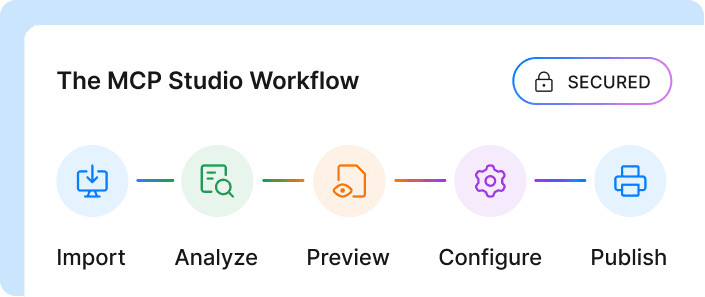
Yes. Every API catalogued from Apigee converts to an MCP tool via MCP Studio in seconds.
MCP tools carry scoped credentials, rate limits, and audit trails. Apigee does not natively expose APIs as MCP tools for LLM and agent framework consumption. DigitalAPI adds this layer above Apigee without touching gateway configuration. The MCP infrastructure is live from day one of the integration.
8. How should I choose between Apigee pay-as-you-go and subscription?
Choose pay-as-you-go when starting with low-volume, high-value APIs and traffic is unpredictable.
Choose subscription when monthly API volumes are predictable and high enough that the included call volume in the subscription tier is consistently used. The crossover point depends on environment type and call volume. Using Google Cloud's pricing calculator with actual projected volumes before committing to a subscription tier prevents overpaying during the first contract period.
Dhayalan Subramanian is Associate Director, Product Growth at DigitalAPI, where he leads go-to-market and product growth for the company’s multi-gateway API management platform. His work focuses on helping large enterprises and mid-market cloud companies consolidate APIs across AWS, Azure, Apigee, Kong, MuleSoft, and other gateways into a single control plane for governance, discovery, monetization, and agent consumption.
Dhayalan brings 14+ years of experience across product strategy, enterprise architecture, and engineering leadership. Earlier in his career, he held senior roles at Encora (as Associate Architect and Technical Manager), Mindtree (Technology Lead), Tech Mahindra (Technical Lead), and Primus Analytics, where he designed integration frameworks and delivered enterprise-grade digital platforms for global customers.
At DigitalAPI, he works directly with platform, integration, and developer experience leaders at Fortune 500 organizations to operationalize unified API catalogs, developer portals, and MCP-ready APIs. He writes regularly on API developer experience, API governance, and AI agent architectures.
One email a fortnight. Worth opening.
A short digest of what we're writing, what we're learning from customers, and the handful of links you'd actually want from us. No tracking pixels.

.avif)