





How to spot failing API platforms even when metrics look healthy
To truly understand how to spot failing API platforms even when metrics look healthy, you need to broaden your perspective.


TL;DR
1. Over-reliance on traditional metrics like uptime and latency often creates a false sense of security regarding API platform health.
2. True failures manifest in developer frustration, inconsistent governance, escalating operational costs, and an inability to innovate.
3. Warning signs include high onboarding friction, fragmented documentation, frequent manual interventions, and a growing number of shadow APIs.
4. A platform is failing if it hinders developer productivity, slows feature delivery, or accumulates technical debt, regardless of green dashboards.
5. Proactive measures—developer surveys, qualitative feedback loops, and internal audits—are crucial for uncovering these hidden vulnerabilities.
6. Shifting focus to developer experience, API lifecycle maturity, and holistic operational efficiency reveals the real health of your API platform.
The digital bloodstream of modern businesses pulses with APIs, powering everything from customer interactions to internal operations. Yet, a peculiar paradox often plagues these vital conduits: an API platform can appear robust and performant on paper, with dashboards glowing green, while secretly teetering on the brink of significant failure. Metrics like uptime and latency, though crucial, offer only a partial, often misleading, view. This illusion of health can lull organizations into a false sense of security, preventing timely intervention. Uncovering these veiled vulnerabilities requires looking beyond the superficial, digging into the qualitative and less obvious indicators that truly reflect a platform's long-term viability and impact. It’s about understanding the subtle decay beneath a seemingly healthy facade.
The Deceptive Glow of Healthy Metrics: Why Dashboards Lie
In the world of API management, metrics are king. Uptime percentages, latency averages, error rates, and throughput numbers are constantly monitored, displayed prominently on dashboards, and often serve as the primary indicators of an API platform's health. When these numbers are consistently green, there's a collective sigh of relief. But what if this green glow is merely a façade, obscuring deeper, systemic issues that are silently eroding the platform's foundation? This is the central challenge when trying to understand how to spot failing API platforms even when metrics look healthy.
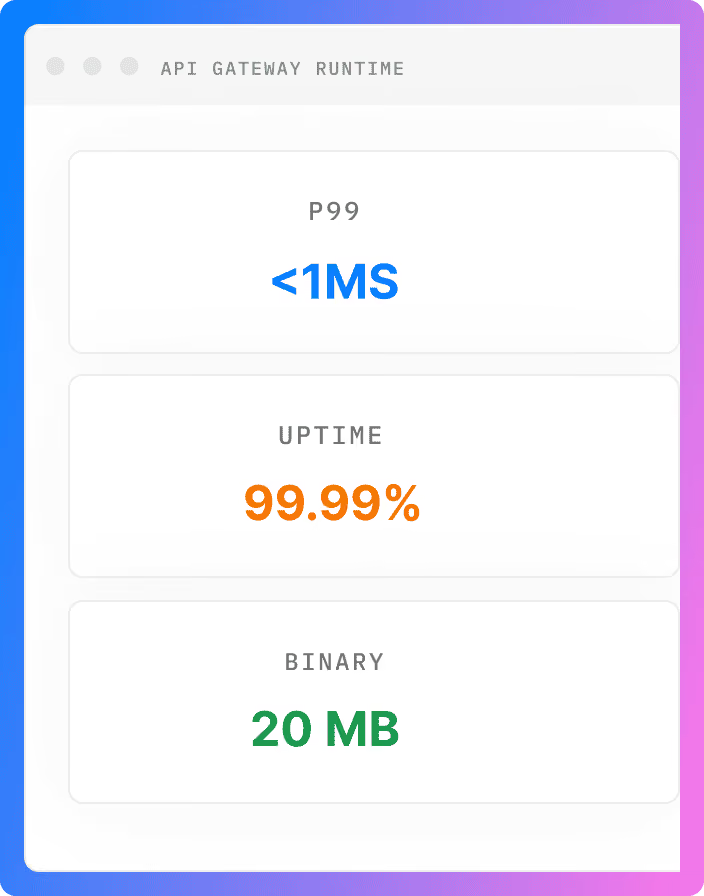
The problem isn't that these metrics are useless; it's that they're incomplete. They tell you *what* is happening at a surface level, but they rarely tell you *why* it's happening, or more importantly, *what isn't happening*. An API might have 99.99% uptime, but if developers can't find it, understand how to use it, or are constantly battling breaking changes, that uptime is largely irrelevant to the platform's overall success. Consider these scenarios:
- Low Latency for Obscure APIs: Your average latency might look fantastic because your most performant APIs are rarely used, while your critical, heavily trafficked APIs are struggling.
- High Throughput, Low Adoption: The platform might process millions of requests, but if these requests are only coming from one or two legacy applications, and new initiatives are bypassing the platform, its strategic value is diminishing.
- Stable Error Rates, Escalating Support: The system might report minimal errors, but if developers are constantly raising support tickets due to confusing documentation, unexpected behavior, or difficult integration processes, the platform is creating hidden costs and friction.
These examples illustrate that while quantitative metrics are essential for operational monitoring, they are insufficient for gauging strategic health, developer experience, and long-term viability. A truly healthy API platform fosters innovation, streamlines development, and empowers business agility, qualities not easily captured by a percentage point or a millisecond measurement.
Beyond the Dashboards: Uncovering Hidden Failures
To truly understand how to spot failing API platforms even when metrics look healthy, you need to broaden your perspective. The real indicators of distress often lie in the qualitative experiences of developers, the operational overhead borne by teams, and the long-term strategic implications that simply aren't visible on a typical performance graph.
1. The Developer Experience (DX) Disconnect
Developer experience is arguably the most critical, yet often overlooked, health metric for an API platform. A platform built for developers is adopted and thrived; one that ignores their needs slowly withers. Even with green metrics, a poor DX signals deep trouble.
- Onboarding Friction: How long does it take a new developer to make their first successful API call? If it involves sifting through outdated PDFs, endless Slack conversations, or complex setup procedures, your platform is failing. A healthy platform offers clear, concise guides, runnable examples, and quick "hello world" tutorials.
- Poor Discoverability: Can developers easily find the APIs they need? If APIs are scattered across multiple repositories, undocumented in private wikis, or lack proper tags and categorization, teams will resort to rebuilding functionality or using shadow APIs.
- Inconsistent or Outdated Documentation: Is the documentation accurate, comprehensive, and up-to-date? If developers constantly encounter discrepancies between docs and actual API behavior, they lose trust in the platform. A thriving platform has living documentation, often auto-generated and tightly coupled with the API lifecycle.
- Lack of Standardization: Are APIs designed with consistent patterns, error handling, authentication, and data models? Inconsistencies force developers to learn new paradigms for every API, slowing down integration and increasing cognitive load.
- High Internal Support Burden: If your API platform team is constantly fielding basic "how-to" questions, explaining undocumented behaviors, or helping resolve integration issues that should be self-service, it's a clear sign of DX failure.
- Shadow APIs: This is perhaps the loudest silent alarm. When developers or business units build their own APIs outside the official platform, it indicates a deep dissatisfaction with the existing offerings. They're solving their problems, but creating governance, security, and maintenance nightmares for the organization.
2. Operational Undercurrents: Beyond Uptime
Operational metrics often focus on the happy path. But the silent strain on your operations teams can reveal a failing platform, even when system metrics are 'healthy'.
- Manual Intervention Dependency: Do deployments, scaling events, or incident recoveries frequently require manual steps? A platform that relies heavily on human intervention for routine tasks is fragile and expensive to maintain, despite its reported uptime.
- Escalating Maintenance Costs: Are the costs associated with maintaining the platform (infrastructure, tooling, personnel) growing disproportionately to its value or usage? This could indicate technical debt, inefficient architecture, or a lack of automation.
- Slow Incident Resolution (MTTR): While the platform might have high uptime, what's the Mean Time To Recovery (MTTR) when an issue *does* occur? If it takes days to diagnose and resolve a problem, the underlying systems are likely too complex, poorly instrumented, or lack proper runbooks.
- Fragile Release Cycles: Are API releases fraught with anxiety, requiring extensive manual testing or frequently resulting in rollbacks? This indicates a lack of robust CI/CD pipelines, inadequate automated testing, or poor versioning strategies.
- Lack of Observability into Business Impact: Can you easily connect API performance metrics to actual business outcomes? If you can't, it's hard to justify investments or identify which APIs are truly delivering value versus just consuming resources.
3. Governance and Compliance Blind Spots
Governance is often seen as a compliance hurdle, but it's fundamentally about ensuring the long-term health, security, and consistency of your API ecosystem. Metrics won't tell you if your governance is broken.
- Inconsistent Security Policies: Are security practices applied uniformly across all APIs? A healthy platform enforces security standards (authentication, authorization, rate limiting) by default, rather than relying on individual team discretion.
- Undefined API Ownership: Is there a clear owner for every API, responsible for its lifecycle, deprecation, and support? Lack of ownership leads to orphaned APIs, security vulnerabilities, and delayed bug fixes.
- Poor Versioning Strategy: Are API versions managed effectively, with clear communication around breaking changes and deprecations? A chaotic versioning strategy leads to consumer frustration and integration headaches.
- Compliance Gaps: Does the platform consistently meet regulatory requirements (e.g., GDPR, HIPAA, PCI DSS)? Metrics won't tell you if sensitive data is exposed through non-compliant APIs or if audit trails are incomplete.
- Ad-hoc API Creation: Is there a structured process for new API development, review, and publication? If APIs are being spun up without proper oversight, it indicates a governance vacuum.
4. Strategic Misalignments: Future-Proofing Your API Platform
A platform can meet today's operational demands while completely failing to address tomorrow's strategic needs. This long-term failure is invisible on daily dashboards.
- Inability to Support New Business Initiatives: Can the API platform quickly adapt to support new products, services, or market opportunities? If it becomes a bottleneck for innovation, it's failing its strategic purpose.
- Technical Debt Accumulation: Is the platform accumulating significant technical debt, making future enhancements difficult and costly? This includes outdated technologies, brittle integrations, and complex, hard-to-maintain codebases.
- Vendor Lock-in Risks: While a specific vendor solution might seem efficient now, does it create significant lock-in that will hinder future flexibility or increase costs disproportionately?
- Lack of Executive Buy-in or Clear Strategy: Is there a clear, communicated API strategy endorsed by leadership? Without it, the platform might become a collection of disparate services rather than a cohesive strategic asset.
- Fragmented Tooling: Are teams using a hodgepodge of disconnected tools for API design, management, testing, and monitoring? This inefficiency creates silos and reduces overall platform maturity.
Actionable Steps: How to Spot Failing API Platforms Even When Metrics Look Healthy
Uncovering these hidden failures requires a proactive, multi-faceted approach that moves beyond simple number crunching. Here’s how to do it:
- Conduct Regular Developer Surveys and Interviews: Directly ask your API consumers about their experience. Use structured surveys to gather quantitative feedback on documentation, discoverability, ease of use, and support. Follow up with qualitative interviews to delve deeper into pain points and suggestions. This is the single most effective way to gauge DX.
- Establish an API Center of Excellence (CoE) or Enablement Team: A dedicated team focused on API best practices, governance, tooling, and developer support can act as an early warning system. They can monitor trends, provide training, and ensure consistency across the API landscape.
- Implement Comprehensive API Lifecycle Management: Ensure every API has a defined lifecycle, from design to deprecation. This includes robust tooling for design-first approaches, automated testing, version management, and clear deprecation policies. This inherently builds transparency and quality into the platform.
- Foster a Culture of Feedback and Open Communication: Create channels (e.g., internal forums, regular town halls) where developers can openly discuss API challenges without fear of reprisal. Transparency encourages early problem identification.
- Focus on Cost-to-Serve and Total Cost of Ownership (TCO): Beyond infrastructure costs, factor in the cost of developer hours spent on integration, support, and rework due to platform deficiencies. This gives a more accurate financial picture than just infrastructure spend.
Conclusion
The true health of an API platform extends far beyond the cheerful green lights on a dashboard. While operational metrics provide crucial insights into system performance, they can be woefully inadequate for identifying the silent killers: a deteriorating developer experience, ballooning operational overhead, governance gaps, and strategic misalignments. Successfully understanding how to spot failing API platforms even when metrics look healthy demands a holistic view, one that prioritizes the qualitative experiences of developers, the efficiency of operational teams, and the long-term strategic value to the business.
By actively seeking out feedback, implementing robust governance, auditing your API landscape, and focusing on the full API lifecycle, organizations can peer beneath the deceptive surface of healthy metrics. This proactive vigilance is not just about preventing outages; it's about building a resilient, innovative, and developer-friendly API ecosystem that truly drives digital transformation and ensures your API platform is a genuine asset, not a hidden liability.
FAQs
1. Why can API platform metrics be misleading?
API platform metrics like uptime, latency, and throughput often represent surface-level operational health. They can be misleading because they don't capture qualitative aspects like developer experience, ease of integration, cost of maintenance, or adherence to governance standards. A platform might technically be "up" and "fast" but still be difficult to use, expensive to maintain, or strategically irrelevant to the business.
2. What are some non-metric indicators of a failing API platform?
Key non-metric indicators include high developer onboarding friction, poor API discoverability, outdated or inconsistent documentation, a significant number of internal support requests, the emergence of "shadow APIs" built outside the platform, slow or fragile release cycles, escalating maintenance costs, and an inability to quickly support new business initiatives due to platform limitations.
3. How can I assess developer experience (DX) for my API platform?
To assess DX, conduct regular developer surveys and interviews, track "time to first API call" for new integrators, monitor internal forum discussions and support tickets for common pain points, and encourage feedback through hackathons or dedicated channels. Look for patterns of frustration related to documentation, API design, or tooling.
4. What role does governance play in spotting hidden failures?
Effective governance ensures consistency, security, and clarity across your API estate. A lack of clear API ownership, inconsistent security policies, poor versioning strategies, or ad-hoc API creation processes are all governance failures that won't show up on a performance dashboard but indicate significant long-term risks and operational overhead.
5. What steps should I take to uncover hidden API platform issues?
To uncover hidden issues, you should implement regular developer surveys, establish an API Center of Enablement, conduct comprehensive internal API audits (discovery, documentation, governance, lifecycle), track qualitative metrics like support ticket volume and adoption rates, and foster a culture of open feedback. Focusing on the total cost of ownership rather than just infrastructure costs can also reveal inefficiencies.
Dhayalan Subramanian is Associate Director, Product Growth at DigitalAPI, where he leads go-to-market and product growth for the company’s multi-gateway API management platform. His work focuses on helping large enterprises and mid-market cloud companies consolidate APIs across AWS, Azure, Apigee, Kong, MuleSoft, and other gateways into a single control plane for governance, discovery, monetization, and agent consumption.
Dhayalan brings 14+ years of experience across product strategy, enterprise architecture, and engineering leadership. Earlier in his career, he held senior roles at Encora (as Associate Architect and Technical Manager), Mindtree (Technology Lead), Tech Mahindra (Technical Lead), and Primus Analytics, where he designed integration frameworks and delivered enterprise-grade digital platforms for global customers.
At DigitalAPI, he works directly with platform, integration, and developer experience leaders at Fortune 500 organizations to operationalize unified API catalogs, developer portals, and MCP-ready APIs. He writes regularly on API developer experience, API governance, and AI agent architectures.


One email a fortnight. Worth opening.
A short digest of what we're writing, what we're learning from customers, and the handful of links you'd actually want from us. No tracking pixels.

.avif)