



How to build your own Drupal portal?
Drupal portal is a centralized web platform built using the powerful open-source content management system (CMS), Drupal.


TL;DR
1. Drupal is a CMS, not a developer portal: Building an API portal on Drupal means you inherit Drupal's update cycles, module compatibility headaches, and security patching schedule, on top of every portal-specific problem you still have to solve yourself.
2. Expect a build, not a buy: A functional Drupal-based developer portal requires custom modules for OpenAPI rendering, authentication, subscription management, and sandbox testing. None of those ship as production-ready defaults.
3. Maintenance compounds fast: Drupal 7 to 9 to 10 migrations, contrib module upgrades, and PHP version bumps consume engineering cycles that should be going into API products.
4. Non-developers still cannot edit easily: Even with Drupal's CMS roots, API reference content, OpenAPI specs, and try-it consoles end up behind developer permissions in practice.
5. Multi-gateway support does not exist out of the box: If you run Kong, Apigee, AWS, or Azure, you will build the gateway integrations yourself, per gateway.
6. Buy the shortcut where it exists: Purpose-built developer portals (DigitalAPI included) shrink the Drupal build into weeks instead of quarters, and remove the ongoing CMS tax entirely.
Get a personalized walkthrough of DigitalAPI's developer portal!
The digital landscape demands more than just a website; it calls for immersive, personalized experiences that connect users directly to the information and services they need. For businesses looking to truly elevate their digital presence and streamline interactions, a well-crafted portal is no longer a luxury, but a strategic imperative. This is where a Drupal portal steps in, offering a robust, flexible, and highly scalable solution to unlock unparalleled business power. From enhancing customer self-service to boosting employee productivity and strengthening partner relationships, a Drupal-powered gateway can transform how your organization interacts with its most vital stakeholders, driving efficiency and fostering deeper engagement.
What is a Drupal Portal?
Drupal portal is a centralized web platform built using the powerful open-source content management system (CMS), Drupal. Unlike a public website designed for broad audiences, a portal typically provides secure, personalized access to specific users or user groups. It acts as a single point of entry where individuals can access tailored information, resources, applications, and services relevant to their relationship with your organization. Think of it as a custom-built digital hub, designed to streamline interactions and improve user experience.
Drupal's inherent flexibility and extensive module ecosystem make it an ideal choice for developing a wide array of specialized portals. Its ability to manage complex user roles, permissions, and vast amounts of content allows businesses to create highly functional and secure environments for various audiences. Whether it's empowering customers with self-service options or providing employees with a collaborative workspace, a Drupal portal is engineered for purpose-driven digital engagement.
Diverse Applications of a Drupal Portal
The versatility of Drupal allows it to power numerous types of portals, each tailored to specific business needs and user communities:
- Customer Portals: These portals empower customers with self-service options, allowing them to access account information, view order history, track support tickets, download resources, and manage subscriptions without needing direct assistance. A well-designed customer Drupal portal enhances satisfaction, reduces support costs, and fosters brand loyalty.
- Employee Intranets/Extranets: An employee Drupal portal serves as an internal hub for staff, providing access to company news, policies, HR resources, collaborative tools, project management systems, and internal applications. Extranets extend this functionality to trusted external partners or contractors, facilitating secure information sharing and collaboration.
- Partner Portals: Designed for distributors, resellers, or service providers, a partner Drupal portal offers essential tools and resources. This includes access to sales materials, training programs, lead registration, co-marketing assets, and performance dashboards, all aimed at strengthening partnerships and driving mutual growth.
- Community Portals: These platforms foster engagement among users with shared interests. A community Drupal portal can feature forums, discussion boards, user-generated content, event calendars, and member directories, building a vibrant online community around a brand, product, or cause.
- Knowledge Hubs: Centralizing knowledge is critical for many organizations. A Drupal portal can function as a comprehensive knowledge base, offering FAQs, technical documentation, how-to guides, and tutorials, making it easy for users (internal or external) to find answers and learn.
Why Drupal for Your Business Portal? Key Advantages and Capabilities
Choosing the right platform for your business portal is a critical decision. Drupal stands out as a top contender due to its unique blend of features, flexibility, and community support. Here’s why a Drupal portal offers distinct advantages for businesses aiming to unlock true digital power:
1. Open Source Advantage: Flexibility, Cost-Effectiveness, and Community Support
Drupal is open-source, meaning its source code is freely available for anyone to use, modify, and distribute. This offers several profound benefits:
- No Licensing Fees: Businesses save significantly on licensing costs often associated with proprietary software, freeing up budget for development and customization.
- Community-Driven Innovation: A vast global community of developers continuously contributes to Drupal's core, modules, and themes, ensuring constant improvement, bug fixes, and feature enhancements.
- Vendor Lock-in Avoidance: The open-source nature means you're not tied to a single vendor. You have the freedom to choose your development partners and hosting providers, ensuring greater control and flexibility.
2. Scalability & Performance: Built to Grow with Your Business
Whether you anticipate hundreds or millions of users, a Drupal portal is engineered for high performance and scalability. It can handle massive amounts of content, high traffic volumes, and complex data structures without compromising speed or stability. Advanced caching mechanisms, database optimization, and support for distributed architectures ensure your portal remains responsive and reliable, even during peak usage.
3. Robust Security: Enterprise-Grade Protection
Security is paramount for any business portal, especially when dealing with sensitive user data. Drupal has a strong reputation for its enterprise-grade security features. It boasts a dedicated security team that proactively identifies and addresses vulnerabilities. Out-of-the-box features include robust user authentication, fine-grained access control, encryption capabilities, and comprehensive logging. This makes a Drupal portal a trusted choice for organizations requiring stringent security compliance.
4. Unmatched Flexibility & Customization: Tailored to Your Exact Needs
Drupal's modular architecture is its superpower. With thousands of contributed modules and themes, almost any functionality imaginable can be added or customized. If a specific feature isn't available, Drupal's robust API and development framework allow for bespoke solutions to be built from the ground up. This flexibility ensures your Drupal portal is perfectly aligned with your unique business processes and branding, offering a truly differentiated experience.
5. Content Management Powerhouse: Structured, Dynamic, and Multilingual
At its heart, Drupal is a CMS, excelling at content organization and delivery. It allows for highly structured content types, robust taxonomies, and flexible content workflows. This means content creators can easily manage diverse information, from articles and documents to multimedia assets. Furthermore, Drupal offers comprehensive multilingual capabilities, enabling businesses to serve global audiences effectively through a single Drupal portal.
6. Integrations Made Easy: Connecting Your Digital Ecosystem
A modern business portal rarely operates in isolation. Drupal's strong API-first capabilities and extensive integration modules make it easy to connect with virtually any third-party system. This includes CRM (Salesforce, HubSpot), ERP (SAP, Oracle), marketing automation platforms (Marketo, Pardot), e-commerce solutions (Shopify, Magento), single sign-on (SSO) providers, and other critical business applications. Seamless integration ensures a unified user experience and data flow across your digital ecosystem.
7. User Management & Personalization: Delivering Tailored Experiences
Drupal provides sophisticated user management features, including detailed role-based access control (RBAC). You can define specific permissions for different user groups, ensuring individuals only see and interact with content and functionalities relevant to them. Combined with personalization capabilities, a Drupal portal can deliver highly customized dashboards, content recommendations, and service offerings, significantly enhancing user engagement and satisfaction.
8. Cost-Effectiveness & Total Cost of Ownership (TCO)
While open source means no license fees, the true cost-effectiveness of a Drupal portal comes from its long-term TCO. Its stability, security, and extensibility reduce maintenance burdens and the need for frequent overhauls. The ability to integrate with existing systems avoids costly re-platforming, and the large talent pool of Drupal developers ensures competitive development and support costs.
9. Future-Proofing: Adaptability to Evolving Business Needs
The digital world changes rapidly. Drupal's architecture is designed to be future-proof, easily adaptable to new technologies, evolving user expectations, and shifting business models. Its regular updates, commitment to modern web standards, and headless capabilities ensure that your Drupal portal remains relevant and performant for years to come, protecting your digital investment.
Totalling up the engineering weeks before you start?
See what a purpose-built developer portal replaces on day one.
Get a Personalized Walkthrough of DigitalAPI Developer Portal!
Core Features and Functionalities of a Powerful Drupal Portal
A truly effective Drupal portal goes beyond basic information display. It incorporates a suite of features designed to empower users, streamline processes, and enhance engagement. Here are some core functionalities typically found in a high-performing Drupal-powered portal:
- Secure User Authentication & SSO: Robust login mechanisms, often integrated with Single Sign-On (SSO) solutions (like OAuth, SAML, or LDAP), provide seamless and secure access for users while maintaining high-security standards.
- Role-Based Access Control (RBAC): Granular permissions ensure that different user groups (e.g., customers, employees, partners, administrators) see only the content and features relevant to their roles, maintaining data integrity and security.
- Personalized Dashboards: Customized landing pages display information, alerts, and quick links tailored to each user's profile, recent activity, or role, making the portal highly relevant and efficient.
- Document & Resource Libraries: Secure repositories for various file types (PDFs, videos, presentations), often with version control, search capabilities, and categorization, allowing users to easily find and download necessary documents.
- Communication & Collaboration Tools: Features like forums, private messaging, announcement boards, event calendars, and shared workspaces foster interaction and collaboration among portal users.
- Advanced Search & Indexing: Powerful search functionalities, often with facets and filters, enable users to quickly locate specific content, documents, or resources within the portal, even across vast amounts of data.
- Workflow & Automation Capabilities: Custom workflows for content approval, support ticket management, application submissions, or other business processes can be automated within the Drupal portal, improving efficiency and consistency.
- Analytics & Reporting: Integration with analytics tools (like Google Analytics or custom reporting modules) provides insights into user behavior, content popularity, and portal performance, allowing for data-driven optimization.
- E-commerce Integration: For customer or partner portals, seamless integration with e-commerce platforms can enable users to make purchases, manage orders, or renew subscriptions directly within their personalized environment.
- Self-Service Options: Capabilities such as updating personal profiles, managing preferences, submitting support tickets, viewing FAQs, or accessing billing information empower users to resolve issues independently, reducing the load on support staff.
Building Your Drupal Portal: A Strategic Roadmap
Developing a powerful Drupal portal is a multi-phase project that requires careful planning, skilled execution, and continuous optimization. Following a structured roadmap ensures that your portal meets business objectives and delivers exceptional user experiences.
Phase 1: Discovery & Planning
- Define Business Goals & User Needs: Clearly articulate what you want the portal to achieve (e.g., reduce support calls, increase employee productivity, enhance partner sales). Conduct thorough user research (interviews, surveys, persona development) to understand the specific needs, pain points, and expectations of your target audience.
- Feature Prioritization: Based on your goals and user research, create a comprehensive list of desired features. Prioritize these features based on business impact, technical feasibility, and user value. This will inform your Minimum Viable Product (MVP) and future development sprints.
- Technology Stack & Integration Strategy: Beyond Drupal itself, identify other technologies required (e.g., hosting environment, database, caching layers). Outline all necessary third-party integrations (CRM, ERP, SSO) and define the data flow and authentication mechanisms.
- Information Architecture (IA) Planning: Design the structure and organization of your content, ensuring logical navigation and discoverability. This includes defining content types, taxonomies, menus, and search filters.
Phase 2: Design & Development
- UX/UI Design: Create wireframes, mockups, and prototypes to visualize the user journey and interface design. Focus on intuitive navigation, accessibility, and a consistent, branded user experience. User testing at this stage can prevent costly redesigns later.
- Core Module Selection & Custom Development: Choose appropriate contributed Drupal modules to implement standard functionalities. For unique business logic or integrations, embark on custom module development. Adhere to Drupal's coding standards for maintainability.
- Theme Development: Build a custom Drupal theme that reflects your brand identity and implements the approved UI designs. Ensure the theme is responsive, providing an optimal experience across all devices.
- Content Migration Strategy: Plan how existing content (documents, user data, legacy system information) will be migrated into the new Drupal portal. Consider automated scripts for large datasets and manual processes for critical content requiring review.
Phase 3: Testing & Deployment
- Security Audits & Performance Testing: Conduct rigorous security audits to identify and fix vulnerabilities. Perform load testing and stress testing to ensure the portal can handle anticipated user traffic and maintain responsiveness.
- User Acceptance Testing (UAT): Engage a group of end-users (customers, employees, partners) to test the portal in a pre-production environment. Gather feedback on functionality, usability, and design, and implement necessary adjustments.
- Deployment & Launch: Strategically deploy the Drupal portal to your production environment. This involves careful planning of server configuration, database setup, and DNS updates. Announce the launch clearly and provide support resources to users.
Phase 4: Maintenance & Evolution
- Ongoing Security & Updates: Regularly apply Drupal core updates, module updates, and security patches to keep the portal secure and stable. This is a continuous process crucial for long-term health.
- Performance Monitoring: Continuously monitor the portal's performance, uptime, and user experience. Use analytics to identify bottlenecks or areas for improvement.
- New Feature Development & Optimization: Based on user feedback, analytics, and evolving business needs, plan and implement new features or optimize existing ones. A Drupal portal should be a living system that continuously adapts and improves.
- User Support & Training: Provide comprehensive support channels (FAQ, help desk) and training materials for users to ensure they can effectively leverage all portal functionalities.
Choosing the Right Drupal Version & Development Partner
The longevity and success of your Drupal portal depend not only on the platform itself but also on the version you choose and the expertise of your development team.
Factors in Choosing a Drupal Development Partner
Selecting an experienced development partner is crucial for the success of your Drupal portal. Look for a team that demonstrates:
- Extensive Drupal Expertise: Verify their proficiency with Drupal's core, contributed modules, custom development, and best practices, specifically for building complex portals.
- Proven Track Record: Review case studies and client testimonials, focusing on previous portal projects they've successfully delivered.
- Strategic Consulting & Discovery: A good partner will guide you through the discovery phase, helping define clear goals, user stories, and a robust information architecture.
- UX/UI Design Prowess: They should have strong in-house or partner UX/UI capabilities to ensure your portal is not just functional but also intuitive and visually appealing.
- Integration Experience: Confirm their experience with integrating Drupal with your specific CRM, ERP, SSO, and other third-party systems.
- Ongoing Support & Maintenance: Ensure they offer comprehensive post-launch support, including security updates, performance monitoring, and ongoing feature development.
- Agile Development Methodology: A partner employing agile methods can offer greater flexibility, transparency, and responsiveness throughout the project lifecycle.
How DigitalAPI replaces the Drupal build?
If you have read this far, you already know the real cost of the Drupal route. It is not the initial stand-up. It is three years later, when your best backend engineer is patching contrib modules instead of shipping APIs, and your product team still cannot edit an overview without filing a ticket. DigitalAPI exists because most enterprise teams eventually reach that conclusion and want a faster path out.
Here is what you get instead, without the CMS underneath.
- A portal built for APIs, not retrofitted from a CMS: Spec viewing, try-it consoles, sandbox provisioning, and subscription management are native primitives, not Drupal modules glued together. There is no Drupal 7 to 9 to 10 migration in your future because there is no Drupal.
- White-label branding without engineering: Custom domain, your colors, typography, and logos. A drag-and-drop theme editor and built-in CMS let a product or partner team publish updates without an engineering ticket. New tenant portals are provisioned in minutes.
- Self-serve onboarding and subscription management: External developers sign up, accept terms, pick a tier, and get a key. Internal engineers request access and get routed to the API owner. Plan tiers, quotas, key rotation (90 or 120-day, per-user), and audit trails handle the full lifecycle.
- Multi-gateway cataloging, out of the box: Point DigitalAPI at Kong, Apigee, AWS API Gateway, Azure API Management, MuleSoft, or APISIX, and your APIs surface automatically in one unified portal. If you acquired a company running a different gateway, it joins the same portal without a second build. This is the single largest piece of work you would otherwise hand-roll on Drupal.
- AI-powered docs and search: DigitalAPI generates API overviews, error explanations, and use-case guides from your OpenAPI specs, and surfaces them through an AI-assisted search that answers questions in context. Drupal gives you a search box. DigitalAPI gives you answers.
- Non-developer content editing that actually works: Product managers, marketers, and technical writers update overviews, value props, and quick-starts through a draft-review-publish flow. No Drupal admin UI to navigate, no content type configuration, no permission matrix. The people closest to the customer can keep the portal current without depending on engineering bandwidth.
- RBAC and role-based visibility built in: Internal APIs stay internal, external APIs stay external, and partner-specific APIs only appear for the partners entitled to see them. You configure this through a UI, not by writing Drupal access rules.
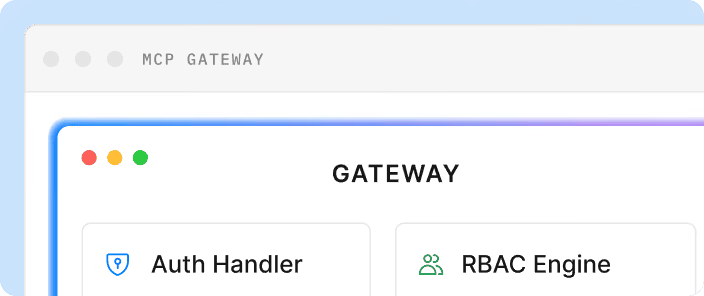
- Sandbox environments and MCP-ready APIs: Isolated sandbox credentials provision automatically for new developers, so partners can test without production risk. For teams exposing APIs to AI agents, DigitalAPI ships an MCP gateway so the same APIs become consumable by agents without building a second integration layer, something no Drupal distribution offers.
- Analytics tied to business outcomes: Per-API, per-partner usage, error heatmaps, and conversion into paid plans. Drupal reports on page views. DigitalAPI reports on who is integrating, who is stuck, and who is generating revenue.
- Comprehensive SDKs: Auto-generated, downloadable code kits in Python, Java, JavaScript, Go, and .NET, distributed via NPM, Maven, and the package managers developers already use. One-click global language switching changes the programming language of every code snippet across the portal, so developers can integrate in their stack of choice.
- Usage analytics and visibility: Consumer dashboards show what's being called, by whom, and how often. Account managers see partner usage and expiry; internal teams see reuse and dependency maps.
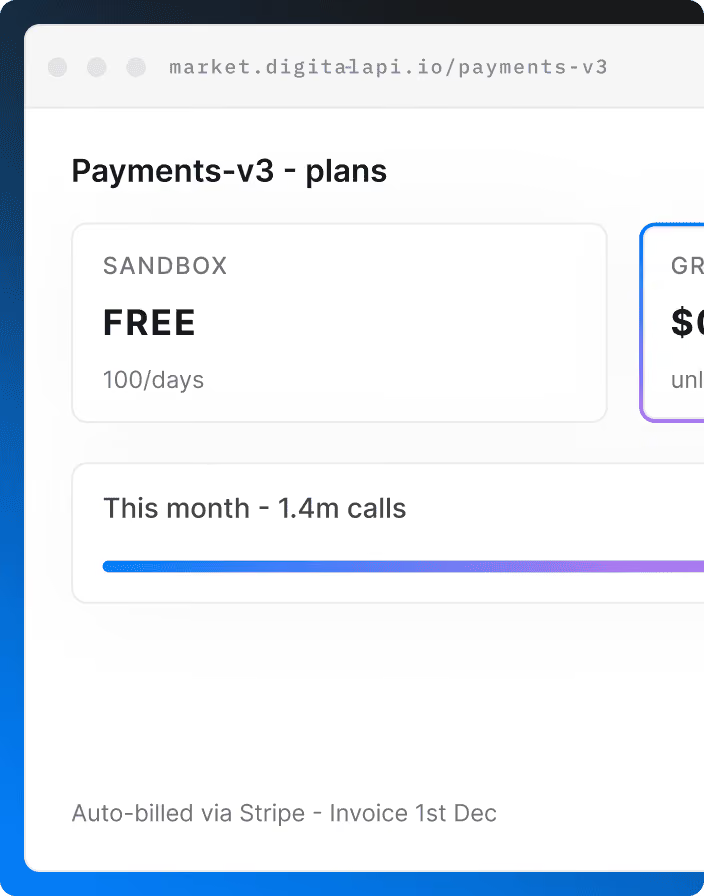
- Monetization ready: Native billing for tiered subscriptions, pay-per-use, and overages, with usage data flowing directly into Stripe, NetSuite, or QuickBooks. Revenue recognition is audit-ready out of the box. Turns external APIs from a support cost into a revenue line without standing up a separate billing stack.
If your team has already scoped a Drupal build and is looking for the cost-benefit comparison, Book a 30-minute demo and we will walk through exactly what DigitalAPI replaces line by line.
FAQs
1. What is a Drupal portal?
A Drupal portal is a secure, centralized web platform built using the Drupal CMS, designed to provide personalized access to specific users or user groups. It serves as a single point of entry for customers, employees, or partners to access tailored information, resources, applications, and services relevant to their relationship with your organization.
2. Why should businesses choose Drupal for their portal?
Businesses choose Drupal for its portals due to its open-source nature (no licensing fees, community support), robust security, exceptional scalability, and unmatched flexibility for customization. It excels in content management, user management with role-based access, and seamless integration with other business systems, offering a cost-effective and future-proof solution.
3. What types of portals can be built with Drupal?
Drupal's versatility allows for building various types of portals, including customer portals (for self-service), employee intranets/extranets (for internal communication and collaboration), partner portals (for sales and training resources), community portals (for user engagement), and knowledge hubs (for centralized documentation and FAQs).
4. What are the key features of an effective Drupal portal?
An effective Drupal portal typically includes secure user authentication (often with SSO), robust role-based access control, personalized dashboards, extensive document and resource libraries, communication and collaboration tools (forums, messaging), advanced search capabilities, workflow automation, and analytics/reporting. It should also be responsive and user-friendly.
5. How does a Drupal portal improve business operations?
A Drupal portal improves business operations by centralizing information and services, leading to increased efficiency, reduced support costs (through self-service), and improved internal communication. It enhances user satisfaction by providing personalized experiences and streamlines workflows, ultimately boosting productivity and strengthening relationships with all stakeholders.
Dhayalan Subramanian is Associate Director, Product Growth at DigitalAPI, where he leads go-to-market and product growth for the company’s multi-gateway API management platform. His work focuses on helping large enterprises and mid-market cloud companies consolidate APIs across AWS, Azure, Apigee, Kong, MuleSoft, and other gateways into a single control plane for governance, discovery, monetization, and agent consumption.
Dhayalan brings 14+ years of experience across product strategy, enterprise architecture, and engineering leadership. Earlier in his career, he held senior roles at Encora (as Associate Architect and Technical Manager), Mindtree (Technology Lead), Tech Mahindra (Technical Lead), and Primus Analytics, where he designed integration frameworks and delivered enterprise-grade digital platforms for global customers.
At DigitalAPI, he works directly with platform, integration, and developer experience leaders at Fortune 500 organizations to operationalize unified API catalogs, developer portals, and MCP-ready APIs. He writes regularly on API developer experience, API governance, and AI agent architectures.

One email a fortnight. Worth opening.
A short digest of what we're writing, what we're learning from customers, and the handful of links you'd actually want from us. No tracking pixels.

.avif)